FCL Builders Podcast Series | Episode 1
O-E-M Spells Success: Partnering with Equipment Manufacturers on Cold Storage Projects
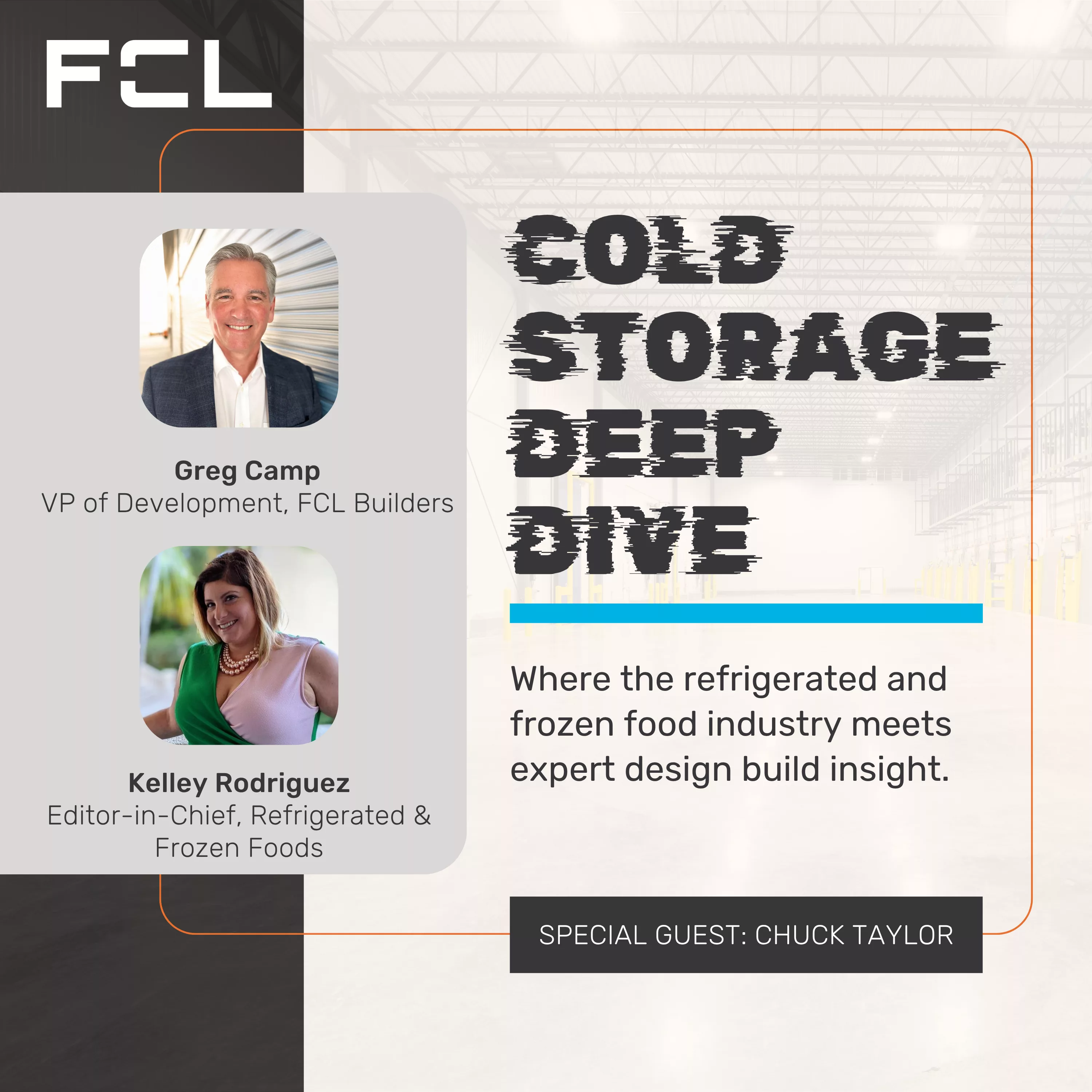
Over the next few months, R&FF is teaming up with FCL Builders to bring you expert perspectives and real world insights from across the cold chain. Joining Editor in Chief Kelley Rodriguez on this special series is Greg Camp, vice president of project development at FCL Builders. Greg brings over 25 years of F&B experience to the industry, including extensive technical expertise in industrial refrigerated environments.
When selecting processing equipment, the choices feed directly into almost every aspect of designing and engineering a greenfield food plant or cold storage facility. When selecting equipment from an original equipment manufacturer (OEM) – such as refrigeration – there are many important questions to ask. The goal is to ensure the equipment will meet current and future needs in safety, efficiency, reliability, regulatory compliance, cost‐effectiveness and integration into your process.
In 2020 Congress enacted the American Innovation and Manufacturing (AIM) which directs the EPA to address hydrofluorocarbon refrigerants (HFCs).
Part of that process is to reduce High Global Warming potential refrigerants used in cold storage warehouses with charges up to 200 pounds or more to 150 by January 1, 2026.
There were several proposed revisions that are under review and out for public comment until November 15. One of those proposed changes was to provide flexibility by raising the GWP threshold to 700 starting in 2026 and delay the GWP to 150 until 2032.

O-E-M Spells Success: Partnering with Equipment Manufacturers on Cold Storage Projects
Chuck Taylor, senior vice president of Engineering at Republic Refrigeration, joins the Cold Storage Deep Dive special series.
Listen to all episodes from the FCL Builders Podcast Series
“(IIAR) made the case that ammonia is the most energy efficient refrigerant, the most cost effective and with the current codes and standards, the safest,” said Chuck Taylor, senior vice president of Engineering at Republic Refrigeration and a licensed professional engineer in 22 states. “Over the last 10 years, the International Institute of All Natural Refrigeration has developed a comprehensive set of standards that have proven so comprehensive that they are now recognized as code. What this legislation has done is drive more innovation is the last seven years than the previous 20 years put together.
“The use of transcritical CO2 has exploded. One of the drawbacks to transcritical has always been that in warmer climates it is not as efficient. Recent technological innovations like the use of injectors and floating compressors has substantially improved that and there is a huge amount of research going on to improve it more,” he said.
With increased automation, comes more heat.
“The thermal characteristics of an automated distribution center are completely different from conventional refrigerated warehouses. The challenge for the cold storage industry is all of these conveyors have motors. All of the palletizers have motors. Everything driven in this warehouse is driven electrically. And all of the work, all of the energy that this equipment puts into that cold space, the refrigeration's got to get it out,” Taylor said. “You've got rise stacks, racks, you have areas with concentrated heat loads, like where the palletizers are, and so it becomes a real challenge to get air distribution to all of these different places.”
For more, listen to the podcast in the player above or download it from your preferred podcast platform.
Looking for a reprint of this article?
From high-res PDFs to custom plaques, order your copy today!