From the Cold Corner
Rethinking the Automated Warehouse of the Future—From the Ground Up
What does it mean to ‘design a facility from the inside out,’ and how does that mindset shape success when implementing automation?

“We've seen a shift on the client side, where it's not just all about labor savings. A lot of it also is being driven how do we do the next step? Automation, is always worth examining, and the question is more ‘where and how much?’ It's not a question of should you, it's where you should and how much,” said Jeremy J. Klysen, business development manager, Burns & McDonnell. “Designing a cold chain facility from the inside-out actually starts constructing a building that supports that operation, so that's why it's inside out, is you have to look at how do you best fit everything up against the automation solution, or solution that's there, whether it's automated or not automated. All the adjacent spaces, as well as then the logistics outside and the flow of truck and auto traffic across the site. It's quite different if you do automate versus if you do conventional. Doing that correctly, we've seen that save four to six months on the front-end design of this, as well as implementation out in the field.”
Engaging early on with automation integrators, OEMs and other project teams (like food safety, logistics and packaging) is vital to keeping a project on time or early.
“It depends on the client, on whether we're starting with a greenfield, or we're trying to fit into an existing facility. The process should define what the building requirements are, as opposed to the other way around,” said David R Campbell, global facilities leader – automated distribution & fulfillment at Burns & McDonnell. “When we include the facility, automation, and operations holistically, you really get a different solution than if you build independently. Understanding the risks involved and really getting the organization ready through a change management process to assess readiness is a key, step.”
Some cases are too cost-prohibitive for renovations.

Rethinking the Automated Warehouse of the Future
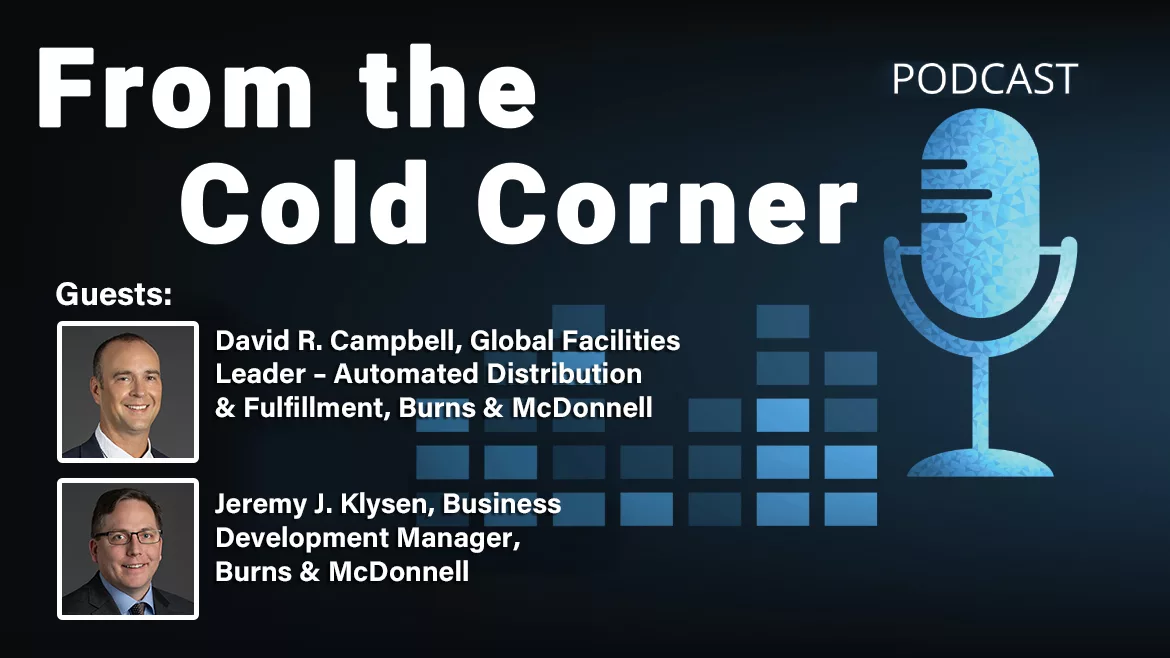
Dave Campbell and Jeremy Klysen from Burns & McDonnell join the podcast to discuss designing cold food facilities for automation and more.
“It almost becomes an exercise, more of a design from the outside in, which is kind of counterproductive to what automation would like to do, so you have to try to figure out how to fit within that space,” Klysen said. “If you're going to do, let's say, an automated frozen warehouse, cranes don't fit so well relative to lower buildings with really thin, slabs. You know, slabs on conventional buildings typically are six to nine inches, and usually the slabs underneath large pallet handling, cranes are somewhere from 12 to 20 inches.”
Before investing in automation, cold chain organizations should assess their operational readiness, via things like simulating different floor layouts during and post construction and using BIM (building information) modeling to manage the overall asset.
“In today’s world, there’s no reason why we shouldn’t be testing 100% of the scenarios. Even if it’s a certain set of SKUs handled outside of automation, here is the process, the workflow to help accommodate those order profiles,” Campbell said. “Automating a bad process doesn't make it a good process.”
What does 2026 hold for the cold foods manufacturing and distribution space?
“Of course, AGVs have been around for a long time, but they're getting smarter and better, they're getting cheaper and now they are not even autonomously guided vehicles, they're autonomous mobile robots that make decisions on themselves using vision and AI. I also really like the 4D pallet mole technology because you don't have the crane aisle and a lower load requirement on your slab,” Cambell said.
Klysen expects fulfillment to be an area of development in the coming year. And implementing automation shows no signs of slowing.
“Finding more of a way in the cold space relative to automating the fulfillment side, that footprint has grown quite a bit. I think the automation's gotten mature enough to get us to that place,” he said. “I think almost every project we're on, they're asking whether they should automate or not; that's quite a different trend than, let's say, even five years ago.”
Looking for a reprint of this article?
From high-res PDFs to custom plaques, order your copy today!