FCL Builders Podcast Series | Episode 3
Cold Storage Design: Digging Into Details
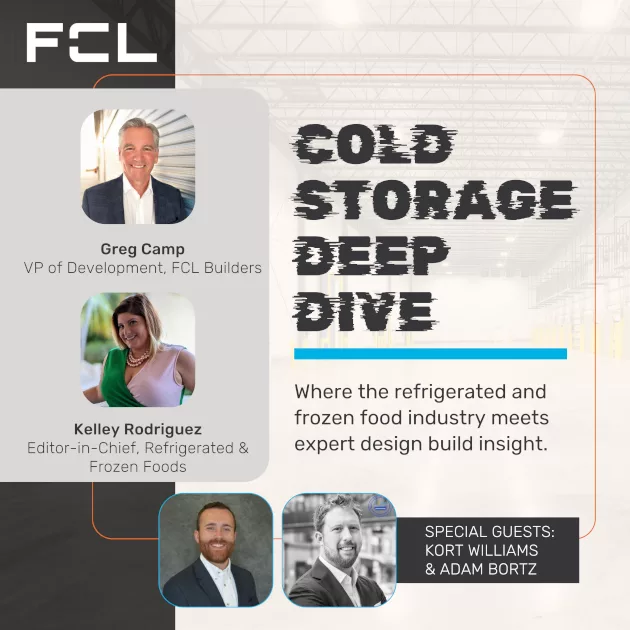
Editor's Note: Over the next few months, R&FF is teaming up with FCL Builders to bring you expert perspectives and real world insights from across the cold chain. Joining Editor in Chief Kelley Rodriguez on this special series is Greg Camp, vice president of project development at FCL Builders. Greg brings over 25 years of F&B experience to the industry, including extensive technical expertise in industrial refrigerated environments.
As demand for temperature-controlled food and pharmaceutical logistics continues to rise, cold storage facilities are becoming more complex—and less forgiving of design missteps.
In this episode of Cold Storage Deep Dive, industry leaders from FCL Builders and Nelson Worldwide explore how safety, design and technology align to ensure long-term performance in cold environments.
Unlike conventional industrial buildings, cold storage facilities operate under intense regulatory scrutiny and extreme physical conditions.
“Every single thing in a cold storage environment ends up in the human body. That reality elevates the stakes for design decisions, particularly as requirements under the Food Safety Modernization Act (FSMA) continue to shape facility standards,” said Adam Bortz, director and account leader of industrial, at Nelson Worldwide.
Temperature differentials between interior and exterior spaces create pressure imbalances that drive moisture into buildings, leading to condensation, ice formation and structural deterioration if not properly addressed.
One of the most critical—and often misunderstood—design elements is moisture control. Cold storage buildings must function as a true six-sided box, with walls, roof, and especially the slab all acting as part of a continuous thermal and vapor barrier system.
“The vapor barrier is absolutely paramount. Once moisture gets into a cold storage facility, the problems multiply quickly,” Bortz said. “Cold storage is much more of a team sport than other industrial buildings.”
Safety considerations begin long before construction starts.
Kort Williams, director of safety at FCL Builders, emphasized that early involvement is key to identifying unique hazards, especially in adaptive reuse projects known as “box-in-a-box” retrofits. These projects convert existing dry warehouses into refrigerated or frozen environments, often creating tight interstitial spaces filled with refrigeration, electrical, plumbing and other considerations like ammonia systems.
“These areas pose fall hazards, confined space risks, and exposure to hazardous materials,” Williams said. “And they don’t just affect construction—maintenance crews will be dealing with these spaces for decades.”
Technology is helping teams manage that complexity. Building Information Modeling (BIM) allows architects, engineers, contractors, and refrigeration specialists to collaborate in near real time, reducing conflicts and accelerating project delivery. BIM also provides flexibility when late-stage changes—such as switching wall systems—inevitably arise.
On the safety front, digital platforms like HammerTech are replacing paper-based systems. These tools centralize site orientations, hazard analyses, safety audits, and incident reporting, enabling proactive oversight and data-driven improvements across projects.
As developers increasingly look to retrofit aging industrial inventory rather than build new facilities, collaboration between experienced design and construction partners is becoming essential. Cold storage is unforgiving of shortcuts, and as the industry pushes closer to population centers for last-mile distribution, the margin for error continues to shrink.
In designing and building temperature-controlled facilities, the details can define whether a facility performs safely, efficiently and profitably for decades to come.

Cold Storage Design: Digging Into Details
When it comes to designing, engineering and building a cold storage facility, the devil is often in the details.
Listen to all episodes from the FCL Builders Podcast Series
Looking for a reprint of this article?
From high-res PDFs to custom plaques, order your copy today!