FCL Builders Podcast Series | Episode 6
ASRS, AI & Adaptability: What's Shaping the Future of Cold Storage
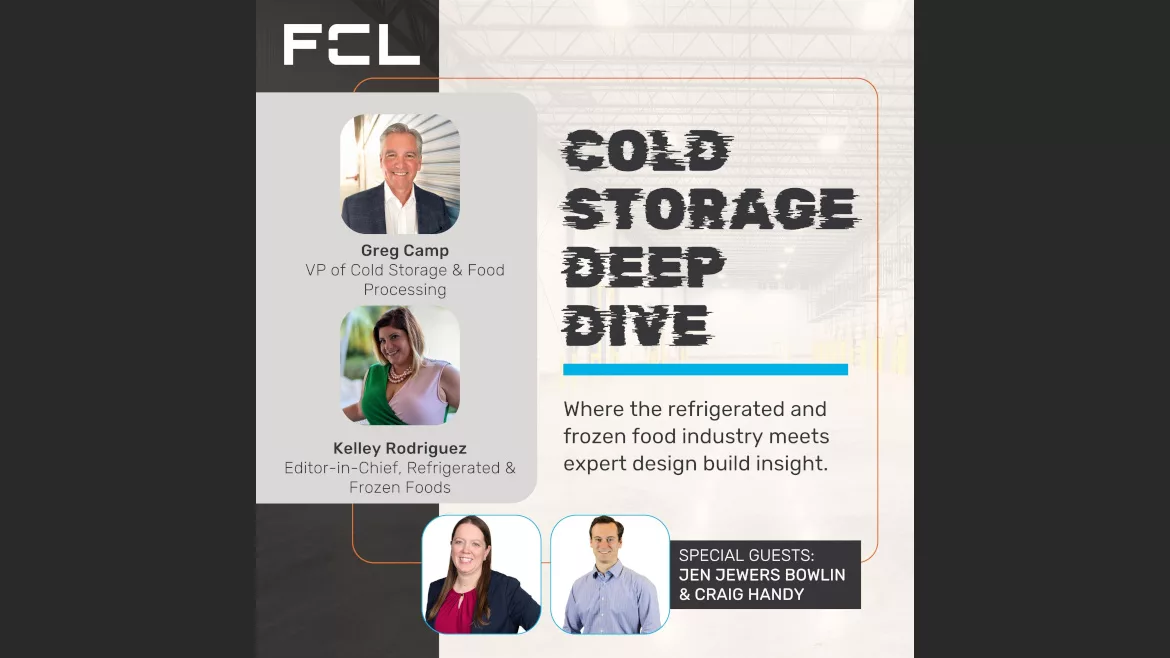
Editor’s Note: This is the final episode in the first season of a special series. R&FF is teaming up with FCL Builders to bring you expert perspectives and real-world insights from across the cold chain. Joining Editor in Chief Kelley Rodriguez on this series is Greg Camp, vice president of cold storage and food processing at FCL Builders. Greg brings over 25 years of F&B experience to the industry, including extensive technical expertise in industrial refrigerated environments.
The U.S. cold storage sector is entering a new phase, as operators balance softer inventories and cautious consumer spending with rapid advances in automation, sustainability and facility design. That evolution is reshaping how temperature-controlled facilities are built — and what they are expected to do.
During the latest episode of the Cold Storage Deep Dive podcast, Jennifer Jewers Bowlin and Craig Handy of Henderson Engineers discussed how flexibility and future-proofing are becoming central to cold storage development.
"One of the big changes we’ve seen is everybody wants things customized. They want it to be able to change as their needs change," said Jewers Bowlin, distribution and cold storage practice director at Henderson Engineers. "You go in with one idea for a building — maybe how much you’re going to do out of that building or what products are going to be going through there — and as the markets and the industry change, they really want that building to be able to shift and grow with their needs."
That demand is driving interest in automation-ready infrastructure, modular temperature zones and facilities that can evolve alongside shifting product mixes and fulfillment strategies. While some operators are implementing automation immediately, others are designing facilities that can accommodate future upgrades.
Handy said adoption often depends on the business model behind the facility, as the high cost of automation remains one of the industry’s biggest barriers.
"If a retailer or a manufacturer is going to build a new large cold storage warehouse, it’s probably going to have an ASRS. It is probably going to be a pretty significant amount of the budget for the total project," Handy said.
As operators seek greater flexibility, interest in smaller, modular automation systems capable of operating across multiple temperature zones has increased. Handy pointed to emerging systems that can pick products from frozen and refrigerated environments within the same automated platform.
"We have a lot of projects right now where they’re going to pick from a frozen space and a 34-degree space using the same automation system. If somebody had asked me six or seven years ago if that was possible, I would have said I don’t know how you would do that," he said.
Beyond automation, growing demand for facilities that support value-added services such as blast freezing, kitting and prepared foods production.
Power availability has also emerged as a major challenge, particularly for retrofit and urban infill projects. Early coordination with utilities has become critical as facilities require more electricity for automation, refrigeration and EV infrastructure.
"Power is definitely a challenge, more so in certain locations than others," Jewers Bowlin said. "It’s really taking that holistic approach of how do we make sure we’re managing all the systems we have to use the least amount of power possible."
Sustainability initiatives continue to influence design decisions as well, from solar integration and energy management systems to natural refrigerants and high-performance building envelopes.
Looking ahead, both engineers expect cold storage facilities to become increasingly automated, data-driven and adaptive.
"I think we’re going to continue to see big gains in smart energy management driven by IoT and AI building management systems," Jewers Bowlin said. "How do we predict what’s going on with the equipment in the space and use that to play into predictive maintenance and fixing things before they break down?"
For an industry once defined primarily by storage capacity, the future of cold chain development may ultimately be defined by intelligence, flexibility and speed.
ASRS, AI & Adaptability: What's Shaping the Future of Cold Storage
In the final episode of the Cold Storage Deep Dive podcast series, Jennifer Jewers Bowlin and Craig Handy of Henderson Engineers discussed how flexibility and future-proofing are becoming central to cold storage development.
Listen to all episodes from the FCL Builders Podcast Series
Looking for a reprint of this article?
From high-res PDFs to custom plaques, order your copy today!