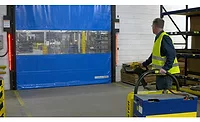
How High-Speed Doors Combat Low-Temp Energy Loss
When it comes to saving low-temp energy, doors are an important component in keeping cold areas sealed. Thanks to recently released study from the Door and  Access Systems Manufacturers Association (DASMA), Cleveland, Ohio, there is some new thinking around door selection that questions the conventional wisdom.
Low temp, high cost
The always high and rising cost of providing chilled air for maintaining product quality is a fact of operational life. For 3PLs especially, the extremely competitive nature of this business means that they are always on the hunt for efficiencies to attract and maintain customers relationships.
Cold air is a major expense, and the mission of management is to use just the needed amount of it. Doorways are the greatest source of cold energy loss every time a door opens and closes.
Facility management went with the idea that for a door to be truly effective in blocking air infiltration, it must seal tightly. Also, the door panel needs to match the insulation to prevent heat transmission, which forces chillers to work harder. But, most food processing and handling operations are extremely busy places, with thickly insulated, lumbering, solid panel doors only getting in the way of increasingly rapid traffic. To handle these heavy traffic demands, cold food processors are encouraged to go with faster doors that have lighter weight panels—like fabric panel roll-up doors— that enlarge their carbon footprint and energy budget. And, retailers such as Walmart are urging that all parts and participants in their supply chain must make their operations greener.
Slow vs. high speed
Turns out the choice between energy and material handling efficiency is not a one or another proposition. Research recently released by the DASMA found that depending on how often a doorway is accessed, faster doors can mean reduced doorway exposure, delivering greater energy-saving benefits beyond R-value.
These findings are changing the way the industry looks at doors and their application. After nearly two years of research by a third-party testing lab, DASMA developed a method to demonstrate the efficiency of high-speed doors in building envelope energy calculations. For the study, the lab used the Rytec PredaDoor, a prototypical, high-speed fabric door, as the model for performance testing and evaluation.
The DASMA research revealed a new perspective in evaluating door energy efficiency. It took into consideration common U-factor, air leakage and motor horsepower values in a comparison of high-speed doors to conventionally operating insulated doors. The study showed doors operating at speeds over 30 inches per second become more energy efficient when cycled 55 or more times per day. The “crossover” point is illustrated in the attached chart.
Depending upon the number of times a door cycles in a day, at some point, door speed takes over from panel insulation in reducing energy loss. For many processing and distribution facilities, a door cycles hundreds of times a day.
Benefits of minimal door opening time
The bottom line is no matter how well insulated and tightly sealed a door may be, neither matters if the door is rarely closed because of frequent use. The doorway is almost always open. The key is minimizing that opening time.
Compared to a conventional door, which can leave the doorway exposed for a considerable amount of time, a high-speed door can have a typical doorway accessible in just two seconds and closed in two seconds once the vehicle passes through. Typical hold-open time for a conventional door can be over 10 seconds. Rapid closing speed means a significant reduction in air infiltration for doors that are often used.
High-speed doors are excellent at controlling air exchange—the air flowing through an opening when a door is not fully closed. In fact, when taking thermal transmittance (i.e. U-factor), air leakage and door power usage into consideration, air exchange can be the most significant part of the total energy loss for a door, depending on the application.
Depending upon doorway usage, air leakage when the door is closed and U-factor can no longer automatically rule out high-speed doors for energy performance. There are doors that have insulated fabric panels that add to the energy saving qualities of high-speed operation in low-temp facilities. For these kinds of doors, a defrost system on the header and the side columns can prevent frost buildup.
Benefits beyond speed
Taking speed into consideration means that a facility can put into play the other benefits of high-speed doors. Indeed, most users are already aware of the lower maintenance required by high-speed doors.
High speed itself means material handling vehicles can rarely catch up with the moving panel to hit it. If they do, many of these doors have a quick reset feature to put the panel back in its track and the door back into operation. This feature too saves energy.
When a slow, solid panel door is hit, it can be misaligned or even worse, the door can be taken out of action and the doorway left exposed. Thanks to the high-speed door’s ability to separate from its side columns when hit, the doorway is always protected against energy loss. Bear in mind that when a conventional solid panel door is disabled and the panels are damaged, as the facility waits for the repair service, the energy loss will be considerable along with the costly effects of the downtime on the operation.
Unlike heavily insulated doors, the lightweight panels and roll-up design on high-speed doors puts less strain on operating parts and requires lower horsepower drives. As a result, downtime and maintenance costs on high-speed doors are minimal.
Then there is the importance of speed to the overall operation. Think of the time drivers and equipment spend waiting for slow conventional doors to open. High-speed doors shaves off seconds from the wait, which translates into hours if not days of eliminated idle time over a year and increasing material handling equipment’s return on investment.
Minimizing doorway exposure pretty much does the job of controlling energy loss. The DASMA study gives management the license to put rapid operating doors to work on their low-temp rooms and keep traffic moving and cold air in its place with confidence.
Looking for a reprint of this article?
From high-res PDFs to custom plaques, order your copy today!