The Benefits of Integrating Spiral Freezers with Process and Refrigeration Control Systems
Integrating a spiral freezer increases efficiency, speeds production and saves energy.
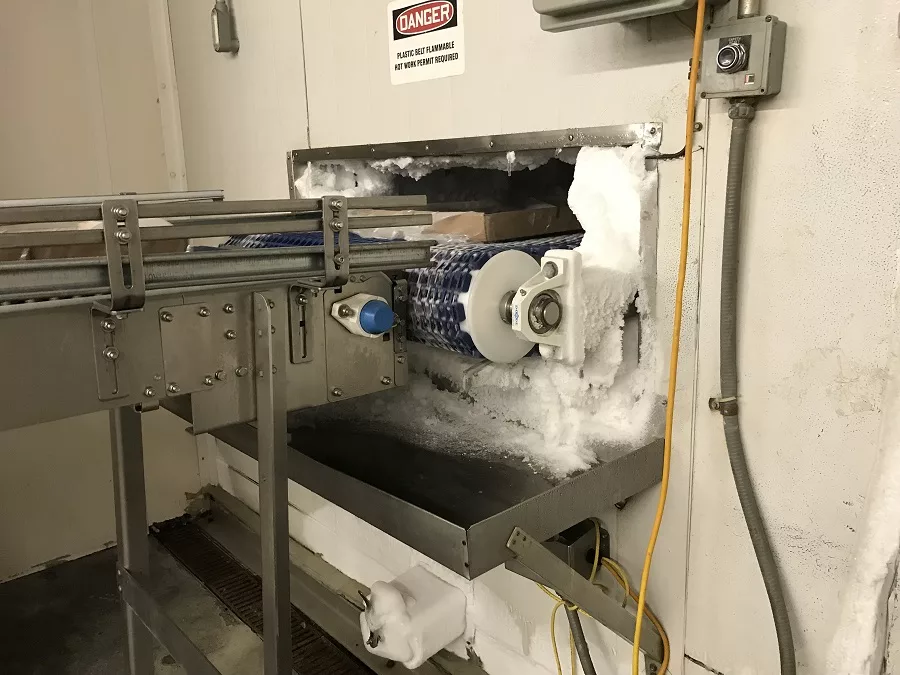
Product enters a spiral freezer on a belt. The belt is moving at a fixed speed to ensure product spends adequate time in the freezer to reach temperature.
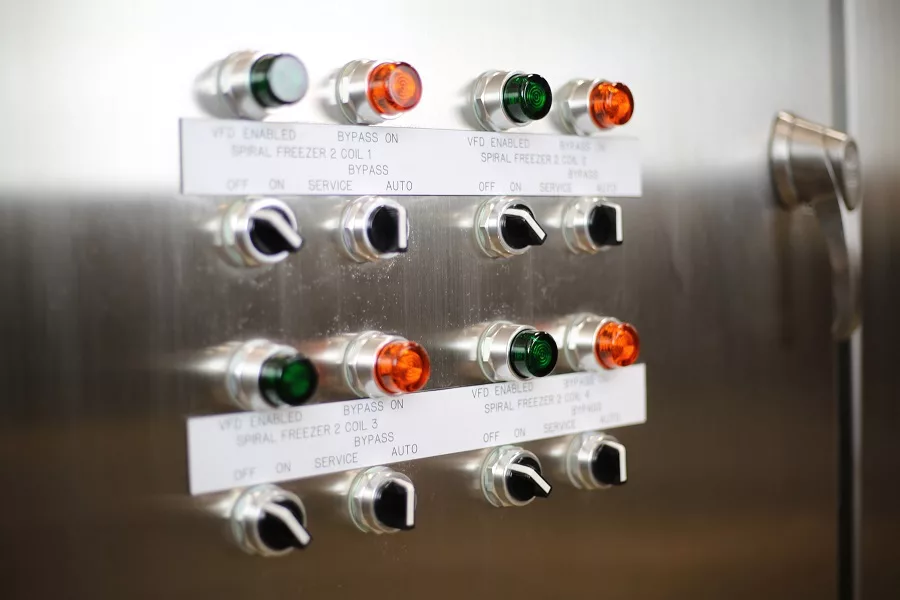
Fan control switches on the outside of a spiral freezer control panel.
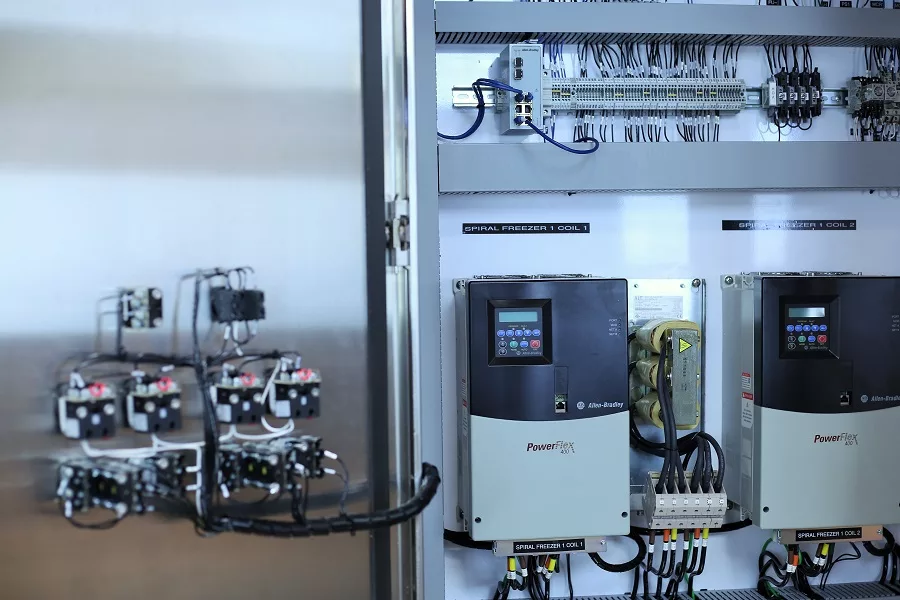
Inside view of a spiral freezer control panel, shown are the VFDs which allow for spiral freezer fan speeds to be varied.
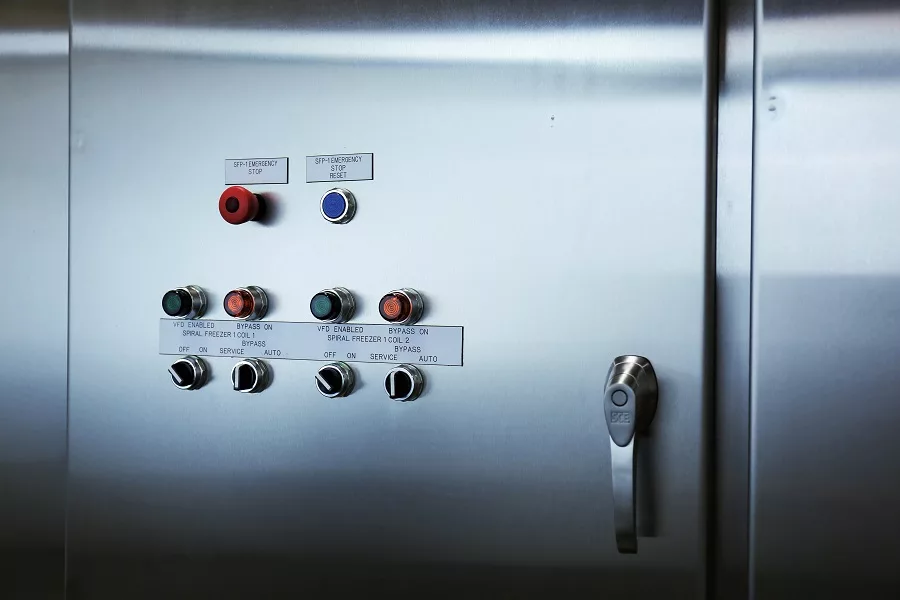
Fan control switches on the outside of a spiral freezer control panel.
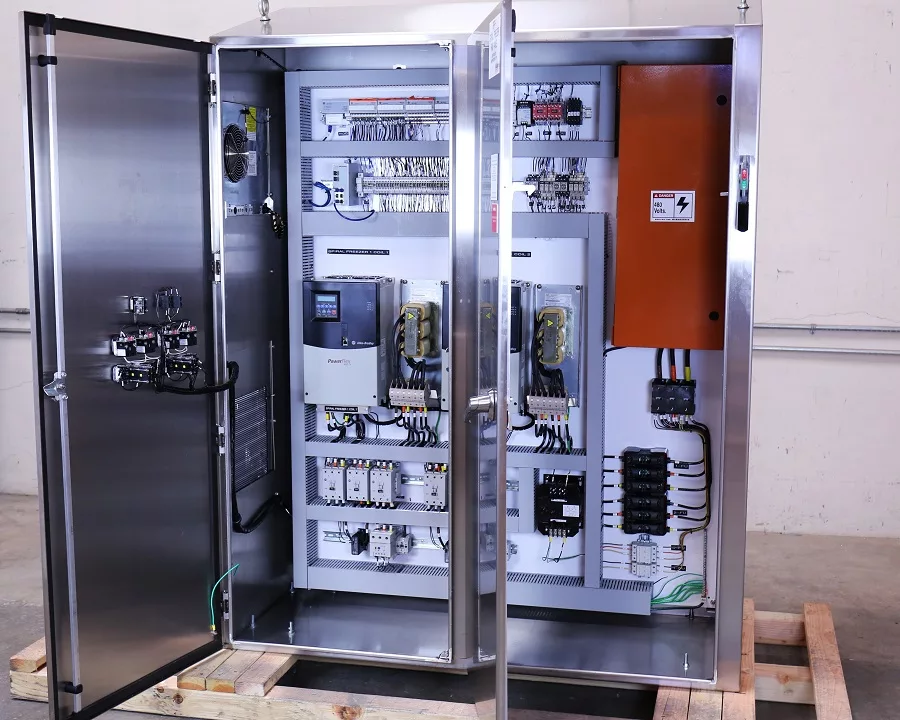
Pre-installation spiral freezer control panel equipped with VFDs for spiral freezer fan speed control.
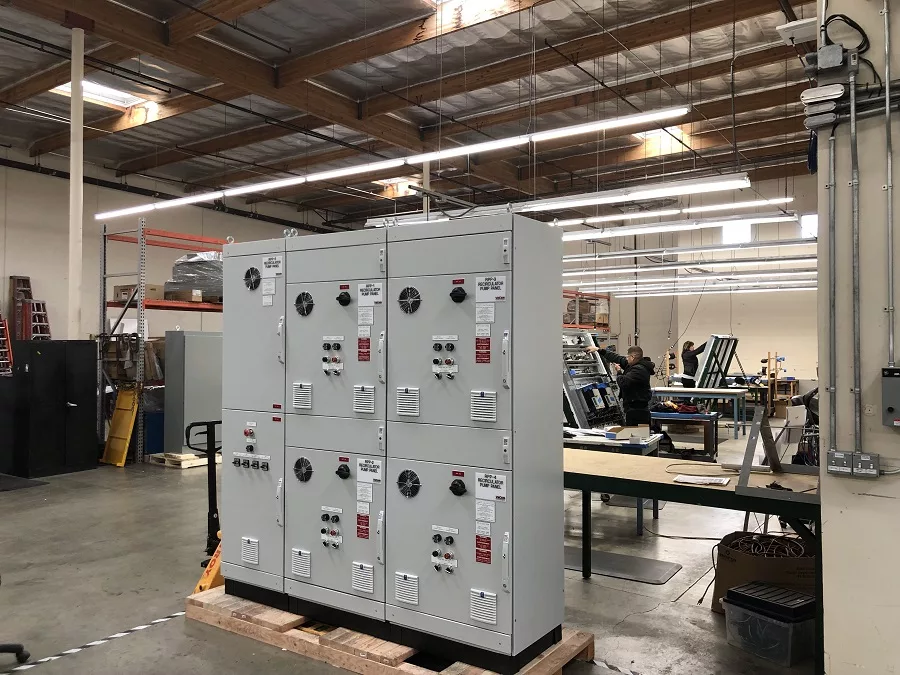
The VaCom Technologies panel fabrication shop, located in La Verne, California.
The purpose of the spiral freezer is to quickly decrease product temperature prior to transporting or placing in storage. Product travels through the spiral freezer on a belt, with the time spent in the freezing process controlled by the belt speed. The enclosed area of the spiral freezer, or box, is maintained at a target temperature, with evaporator fans operating at a defined speed to maintain air flow across product while the evaporator coils remove heat from the space.
There are three key operating parameters for the spiral freezer: belt speed, temperature, and air flow. Target product temperatures at the outlet of the spiral freezer typically vary due to differing product geometry, weight, and ingredients. If a spiral freezer is operated at the highest fan speed and lowest temperature, some products may become over frozen, which can result in breakage and poor performance in end use. End use impacts can vary depending on the type of product, for example a raw yeast product not properly rising. For some facilities, the product mix is diverse so the required operating conditions for each product can vary significantly.
A spiral freezer should not operate alone
A plant may already have defined parameters for each product that are updated at the beginning of each product run. Typically, spiral freezers are not fully integrated with the production or refrigeration control system. This “island of automation” results in the need for manual entry of the defined parameters, which introduces its own set of challenges.
Human error can often lead to product issues when setpoint changes aren’t properly made. These errors are often related to setpoint changes made as a temporary fix for production issues, which are then forgotten, resulting in increased energy use and impacts on product quality. These changes can be easily forgotten in product changeovers as well.
For example, if a production line is changing over from a product that requires a -10°F box temperature to one which requires a -20°F box temperature and the temperature setpoint is not updated for the spiral freezer, there is risk for warm (or soft) product, which will not pass quality checks. In addition to potential lost product, this impacts workflow for other departments, as analysis of the warm product pulls resources from other plant responsibilities (such as maintenance).
Typically, in reaction to product exiting the spiral freezer at the incorrect temperature, the temperature setpoint is lowered and fan speeds increased, which both have large impacts on energy usage, resulting in increased utility costs. In contrast, for products which are freezing well, the spiral freezer belt speed may be increased to speed up production rate. However, this increase in production rate may not outweigh the energy savings for running the belt slower with a higher temperature setpoint and lower fan speed. Ideally, the temperature, fan speed, and belt speed would be optimized to balance the need for a high production rate and energy savings.
To address these issues, VaCom Technologies has developed a method to integrate the spiral freezer control with the refrigeration and process equipment control systems. This allows the spiral freezer parameters to automatically update based on which product is being produced. We work with the plant staff as a team to initially determine the optimal parameters for each product (or family of products) to achieve the desired product temperature and optimize the equipment operation to save energy. The amount of testing required depends on product range. Going through the testing process with direct support from VaCom prepares the plant staff to update parameters in the future as new product is introduced. It is key for plant personnel to have confidence in the testing method to enable them to push for the most optimal performance without fear of lost product.
Energy savings can be substantial, particularly for facilities which have been operating “all-out” with the lowest possible temperatures and highest fan speeds. By dynamically adjusting the spiral parameters, the system more efficiently handles the load as it varies. Loads vary based on product, but seasonal impacts are also a factor. For example, some facilities experience higher loads in the summer versus the winter as ingredient temperatures are warmer. The flexibility of the controls allows for seasonal spiral freezer parameters to be defined, maintaining optimal performance throughout the year. Paired with our control systems, full integration allows for the entire refrigeration system to operate optimally, eliminating the need for manual intervention.
Integrating spiral freezer controls with the main refrigeration and process controls is a great solution for improving product temperature control and system efficiency. Automating the product changeover process eliminates processes that are vulnerable to human error, allowing for those personnel hours to be better spent elsewhere. This not only benefits the production and maintenance personnel who are directly interacting with the equipment each day, but also the upper management who are seeking to reduce overall costs by saving energy and avoiding unnecessary downtime.
Looking for a reprint of this article?
From high-res PDFs to custom plaques, order your copy today!