Introducing Lithium-Ion Forklifts to a Cold Storage Environment
Analyzing forklift performance can maintain or increase throughput while lowering energy costs.
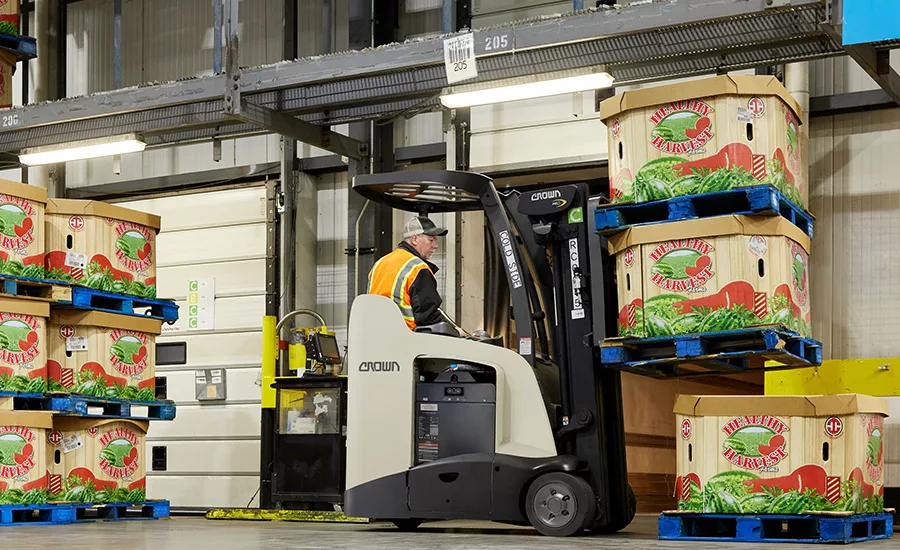
The V-Force lithium-ion battery is warranted for up to 3,600 cycles, providing up to three times more daily throughput of its rated amp hour capacity than a comparable lead-acid battery. Courtesy Crown Equipment
The cold chain continues to be one of the fastest-growing sectors in supply chain logistics, primarily propelled by increased frozen food sales and the growing popularity of weight-loss drugs, which need to be stored in refrigerated environments.
To keep pace with consumer demand and combat the high energy costs associated with cold storage applications, cold storage facility operators look to productivity solutions to help maintain or increase throughput. This includes analyzing the performance level of the forklifts used in these environments.
As part of this focus on forklift productivity and performance, supply chain managers are starting to take a closer look at their fleets’ power sources. Forklift batteries—whether lead-acid or lithium-ion—are a determining factor on how well your supply chain performs.
Lead-Acid Battery Concerns in Cold Facilities
Most cold storage facility managers are well aware that lead-acid batteries do not operate well in cold storage environments. Lead-acid batteries automatically lose 30% of their rated capacity when used in temperatures below 32° Fahrenheit. This means if you buy a 1,000Ah battery, you will have just 70% of that battery’s available capacity accessible as actual runtime. Right from the beginning, the battery’s discharge/charge cycle life is greatly shortened.
This also means shorter run times before the battery needs to be switched out and returned to the battery room to be charged. Operators typically leave cold storage environments to go to charging areas or battery rooms to make this change. This frequent transition between cold storage and ambient temperatures can cause condensation to form, which can lead to performance issues, wet floors and potential downtime.
Additionally, cold lead-acid batteries can also experience an artificial spike in voltage when charging. Since the operator and the charging station most likely will not know the battery’s temperature, charging may be stopped too soon, resulting in the battery being short charged. Over time, this can affect the battery’s capacity retention and shorten its lifecycle.
Until recently, these performance issues and limitations were considered part of the cost of doing business in cold storage environments. That mindset is changing as lithium-ion batteries become a viable option.
Benefits of Changing Batteries
Along with eliminating issues mentioned above, lithium-ion batteries can provide additional benefits in cold storage operations. Compared to lead-acid batteries, lithium-ion batteries offer the following benefits:
- Less maintenance and reduced risk during service: Lithium-ion batteries do not require watering. They also don’t expose employees to hazardous gases or chemicals during battery servicing and charging.
- Faster and more convenient recharge: Compared to lead-acid, lithium-ion batteries can be charged faster and more efficiently. Lithium-ion power solutions can be integrated into the forklift, so the battery doesn’t need to be removed during charging. They can be opportunity charged during operator breaks without leaving the cold storage environment and do not require a cooling period after recharge.
- Reclaimed storage space: Operations using lead-acid batteries typically have on-site battery rooms, space set aside in the warehouse for battery storage, charging and maintenance. Multi-shift operations can require up to three lead-acid batteries per lift truck to allow for proper discharge, charge and cool-down times. Since lithium-ion batteries can be opportunity charged within the lift truck, most operations can eliminate battery rooms and reclaim the space for storage.
Because of these advantages, lithium-ion batteries do require a larger upfront investment. It is important to carefully consider if the technology is right for your operation. The following four tips can help guide an informed decision.
- Know your power profile: Forklifts consume power differently depending on the application, operator and driving patterns. A power study can help you determine if introducing lithium-ion batteries is the right choice for your operation by helping you understand your current power needs and how your lift trucks are operated. It also can help with recommendations on battery size and charging methods. For instance, a study of a fleet using lead-acid batteries may show idle time is high, the power consumption rate is low, but the batteries do not last an entire shift. There may be a strong case to transition to lithium-ion power in such an application. Not only can lithium-ion batteries charge more quickly and efficiently, they can also power forklifts through the entire shift and ultimately improve uptime.
- Choose an integrated lithium-ion forklift system: Seamless integration of lithium-ion technology into the forklift helps maintain performance, efficiency and safety standards of the original design and unlock benefits inherent in today’s more intelligent forklifts. A fully integrated lithium-ion forklift system leverages on-board intelligence in the battery and conveys forklift system information, preserving performance of the forklift’s safety features. This includes making sure the forklift is not actively lifting or lowering and can be safely brought to a stop as the charge level reaches a predetermined threshold. For use in cold storage environments, it is important to select a lithium-ion battery that is equipped with an on-board low-draw heater that helps prevent performance issues in low-temperature environments. An integrated approach enables service technicians to support the entire system, including the forklifts, batteries and chargers. The combined knowledge of the forklift’s operation helps maintain the desired level of integration and performance between these components.
- Consider your charging station and location: Chargers are available today that operate in cold storage environments. This reduces the number of times the forklifts need to leave the cold storage area to charge, which minimizes the risk of condensation. They also free up valuable warehouse space in your ambient temperature area. When placing your charging stations, ensure adequate room to properly position forklifts for charging. This can be especially important if you co-locate two or more charging stations. Consideration should also be given to pedestrian and operator access, location of the lift truck’s charge port, the direction of lift truck travel and the available charger mounting locations. Incorrect charging station configuration can lead to improper cable management, which can cause undue stress on cables and connections. This may lead to premature wear and faulty connections, which can lead to charging failures due to excessive heat during charging. Battery charging cables and connectors can become a common failure point when using lithium-ion batteries since these batteries are intended to be opportunity charged, requiring more frequent connections and disconnections throughout a shift.
- Ensure the necessary operator training: Most importantly, you should consider how using lithium-ion technology affects your forklift operator training. Even if you follow the previous three tips, the advantages provided could be minimized without the necessary training in place. Operators should understand how the technology is different from lead-acid batteries and how they may need to modify their behaviors to yield longer runtime and extended battery life.
Lithium-ion technology can provide a solution to many of the performance issues lead-acid batteries encounter in cold storage environments. Before you introduce lithium-ion to your facility, you need to first determine if it is right for your operation. This will help ensure you realize the ROI and benefits that lithium-ion technology can deliver.
Looking for a reprint of this article?
From high-res PDFs to custom plaques, order your copy today!