How Advanced Fluid Engineering Contributes to a More Reliable Cold Chain
From critical refrigeration units to workhorse applications in food processing facilities, lubricants are essential in reliable food processing.

To achieve greater efficiency, food processing equipment often runs faster and hotter, requiring lubricating fluids capable of withstanding both food safety and operational conditions.
Maintaining dependable cold chains is critical for the health and safety of consumers everywhere. And it’s not easy, requiring a variety of critical infrastructure from initial food processing operations all the way to supermarket shelves.
One key component that may not always be top of mind for food processing professionals: lubricating fluids. These fluids help protect important componentry that contributes to a dependable cold chain. Whether in gear boxes, refrigerating compressors or other applications, lubricants enable critical machinery to function dependably for more resilient cold chains.
This article explores the important role lubricants play throughout food processing and cold chains, how lubricants must balance the need for food safety with necessary performance, and how the advent of more sustainable refrigerants is creating new challenges that next-generation fluids and lubricants must overcome.
Balancing Food Safety with Throughput
Lubricants are deployed in countless applications throughout food processing operations. They are used to lubricate gears and moving parts in conveyor lines, industrial mixers or blenders, heat exchangers, air compressors, cleaning equipment and other critical infrastructure that goes into safe and reliable food processing.
Because lubricants have the potential to come into contact with the foods being processed, they must adhere to food-grade classifications as defined by NSF International. Lubricant classifications include:
- NSF H1: These lubricants are for use in food processing areas where there is a possibility of incidental contact with food. They must be tasteless, odorless and are considered “above the line,” meaning they are often used above or near conveyor belts where food is being processed.
- NSF H2: H2 lubricants are for use in food processing areas where there is absolutely no possibility of food contact. They do not contain heavy metals or other harmful substances like carcinogens or mutagens.
- NSF H3: these are soluble oils, often for controlling rust on equipment such as cutting blades.
EXPLORE MORE


Within the parameters of these classifications, lubricants used throughout food processing must carefully balance performance requirements for their given application while maintaining food safety. It can be helpful to examine both the primary responsibility of any lubricating fluid and how that fluid maintains those performance characteristics.
The lubricant’s job is to reduce friction and wear between moving parts. Formulation choices influence how well it performs that job. Consider that a lubricating fluid is primarily made up of two important ingredients:
- A base oil, which serves as the carrier fluid and delivers desired performance. It makes up the majority of the formulation and is a critical building block for a high-quality lubricant. In addition to protecting surfaces, it provides a mechanism to remove heat while sealing and protecting the surfaces.
- Additives, which serve as performance enablers and allow the finished product to meet operational requirements when in use. They are to enhance properties such as providing additional wear protection, anti-corrosion and oxidative stability.
A lubricant used in a food processing area may be formulated with a different set of additives than a conventional lubricant. For example, zinc-based additives have long been used in industrial lubricants for wear protection and oxidative control. However, these additives may not be suitable for a food grade product. Ingredient classifications for food grade lubricants are specified by NSF as follows:
- HX-1. Ingredients for use in H1 lubricants (incidental contact).
- HX-2. Ingredients for use in H2 lubricants (no contact).
- HX-3. Ingredients for use in H3 lubricants (soluble oils).
Different base oils may also be selected based on performance and food requirements.
And in today’s industry, lubricant performance must continually reach new heights. Food processing machinery OEMs are continually working to improve the efficiency of equipment. For example, to achieve greater efficiency, industrial equipment often operates faster and hotter; lubricating fluids must accommodate those increasingly severe operational conditions. This further challenges formulators within the boundaries of food safety, requiring OEMs to work closely with fluid suppliers to meet growing and changing needs within the cold chain.
Navigating Shifting Refrigerant Technology
One of the most important applications where lubricants are found throughout food processing is within refrigeration compressors. These applications are at the core of the refrigeration cycle throughout the cold chain, from industrial coolers and freezers to cold transport vehicles to supermarket shelving.
It can first be helpful to take a closer look at how compressors function. First, the compressor takes a low-pressure, low-temperature refrigerant vapor and compresses it into a high-temperature, high-temperature refrigerant vapor. Next, the vapor flows into the condenser where it cools the refrigerant vapor into a liquid. The liquid refrigerant is then boiled off in the evaporator and the refrigerant vapor then heads back to the compressor and begins the cycle again. Throughout this process, lubricating fluids are responsible for enabling the movement of the refrigerant, as well as protecting metallic parts in the compressor and enabling them to function efficiently.
Within this application, fluid performance can be impacted by external operational factors. A compressor located in an engine room may experience higher temperatures, requiring the compressor to work harder to provide cool temperatures. Such conditions can create greater stress on the lubricant. Conversely, lubricants operating in extremely cold environments can face other challenges. Here, flow and viscosity can be compromised, creating performance issues that may lead to premature wear on compressor parts.
Importantly for refrigeration compressors, lubricant interaction with refrigerant gases must be considered—and today, this interaction presents one of the most important challenges faced by compressor OEMs and lubricant formulators. Recent environmental legislation has prompted an ongoing shift from traditional hydrofluorocarbon (HFC) refrigerants to those with a lower global warming potential (low-GWP). These new low-GWP refrigerants include hydrofluoroolefins (HFOs), HFO blends, hydrocarbons, carbon dioxide (C02), and ammonia (NH3).
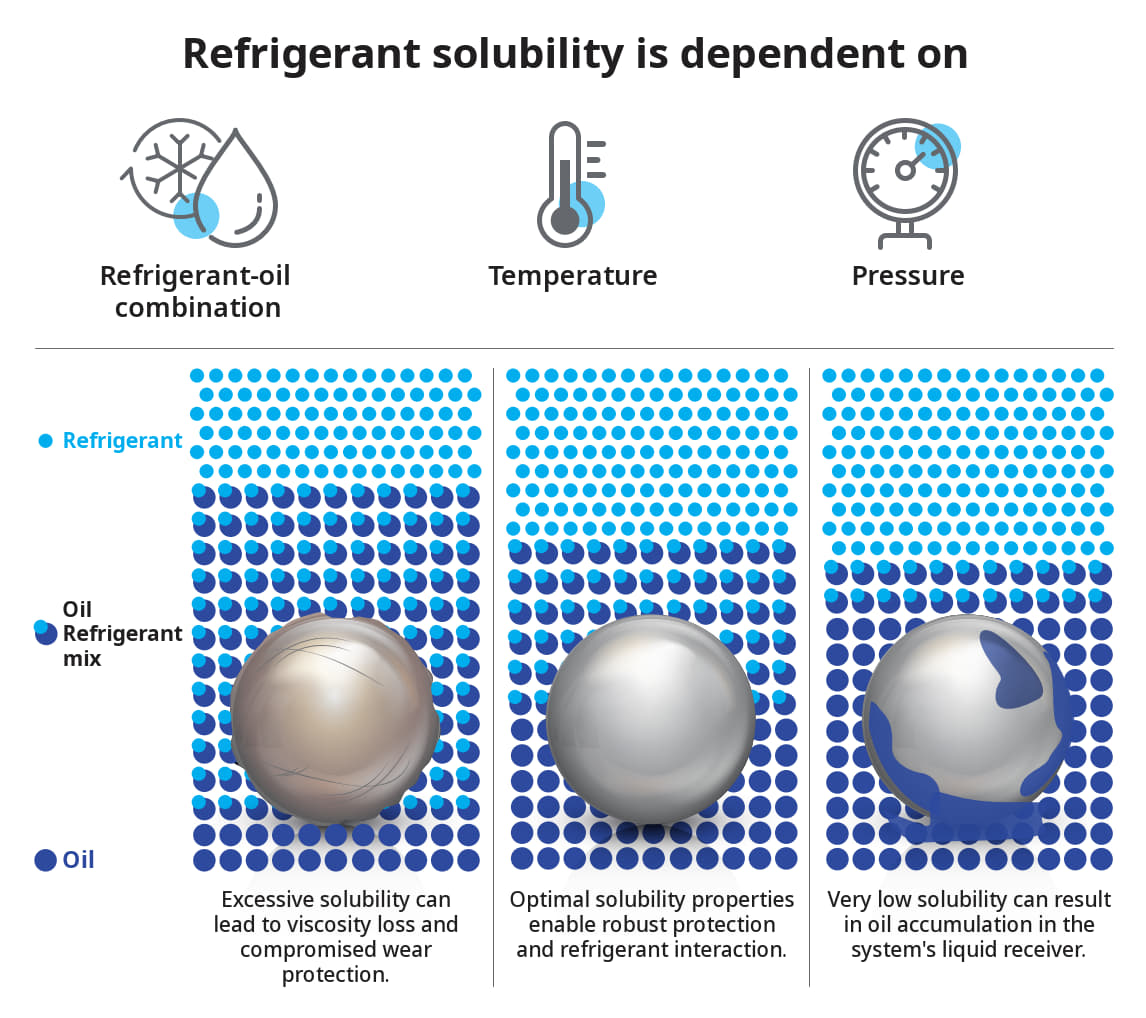
These new refrigerants bring with them different challenges in how they interact with the lubricant. For example, a refrigerant's ability to dissolve into the compressor oil is a critical interaction that influences system performance by affecting the lubricant's viscosity and the oil's ability to return to the compressor. More refrigerant solubility in the oil leads to a significant decrease in oil viscosity, potentially causing insufficient film strength and increased wear. Conversely, very low solubility can result in oil accumulation in the system's liquid receiver, hindering its proper transport back to the compressor. This solubility is dependent on the specific refrigerant-oil combination, as well as temperature and pressure, making it essential to select appropriate lubricants based on these factors for system reliability and efficiency.
The sheer complexity of new refrigerants entering the marketplace further complicates matters for compressor OEMs who will need to specify the right type of fluid to meet the needs of changing equipment. Many compressor OEMs have retrofitted their equipment to handle the emerging refrigerant gases. However, the transition to novel low-GWP options has caused design divergence. Close collaboration with refrigeration and industrial lubricant suppliers will be essential for OEMs to identify formulations that contribute to optimal performance, reliability and longevity. Lubricant solutions should be designed for compressor type, operating conditions and refrigerant gas selection, based on a deep understanding of the necessary criteria the system requires.
To meet these needs, a “chemistry agnostic” approach can be beneficial. No single additive/base oil change will properly accommodate all new low-GWP refrigerants and forward-thinking formulators should account for such. Indeed, OEMs should seek out the best lubricant option for the given application and a partner that can deliver.
Elsewhere, when evaluating fluid suppliers, food processing professionals can look for experience throughout the industrial and refrigeration lubrication space, backed by expertise and technical support. These qualities are essential as OEMs continue to navigate the new frontier of low-GWP refrigerants and food grade applications.
Looking for a reprint of this article?
From high-res PDFs to custom plaques, order your copy today!