A Brighter Approach to Cold Chain Operations
From improved visibility on the production floor to lower refrigeration loads, today's lighting systems are becoming an important part of cold facility performance.
A 2025 study of over 100 senior energy decision-makers at F&B companies found 91% pay above the $0.08/kWh U.S. industrial average and nearly half saw costs rise 26% or more over five years.
From the production floor to the loading dock, lighting influences nearly every aspect of refrigerated and frozen food operations. Beyond improving visibility, today's lighting systems can support energy efficiency, sustainability initiatives, food safety and the overall employee experience.
"By reducing both energy use and heat generation, lighting can play a supporting role in overall facility efficiency and refrigeration demand management," said Andy Kraft, industrial sales director at Acuity Brands, North America’s largest lighting company.
Unlike legacy high intensity discharge (HID) fixtures, which generate significant heat, or fluorescent lighting, which can create challenges in certain food processing environments such as dairy plants, LED technology has emerged as the preferred choice for food manufacturing, processing and cold storage facilities. Depending on system design and operating conditions, LED fixtures can reduce power consumption while lowering the heat introduced into refrigerated environments.
Additional benefits include:
- Instant-on operation with no warm-up or restrike delay
- Stable performance in low-temperature environments
- Improved visibility in tall rack aisles through more uniform light distribution
Manufacturers continue to develop fixtures tailored specifically for harsh refrigerated and frozen environments.
California-based 1st Source Lighting says traditional LED retrofit calculations often overlook the unique operating conditions inside cold storage facilities. Because its LEDs are engineered with a negative thermal coefficient, the company says the fixtures become brighter and up to 10% more efficient at colder temperatures.
Its Vapor Tight series is hermetically sealed to withstand clean-in-place (CIP) washdowns while eliminating areas where bacteria can accumulate.
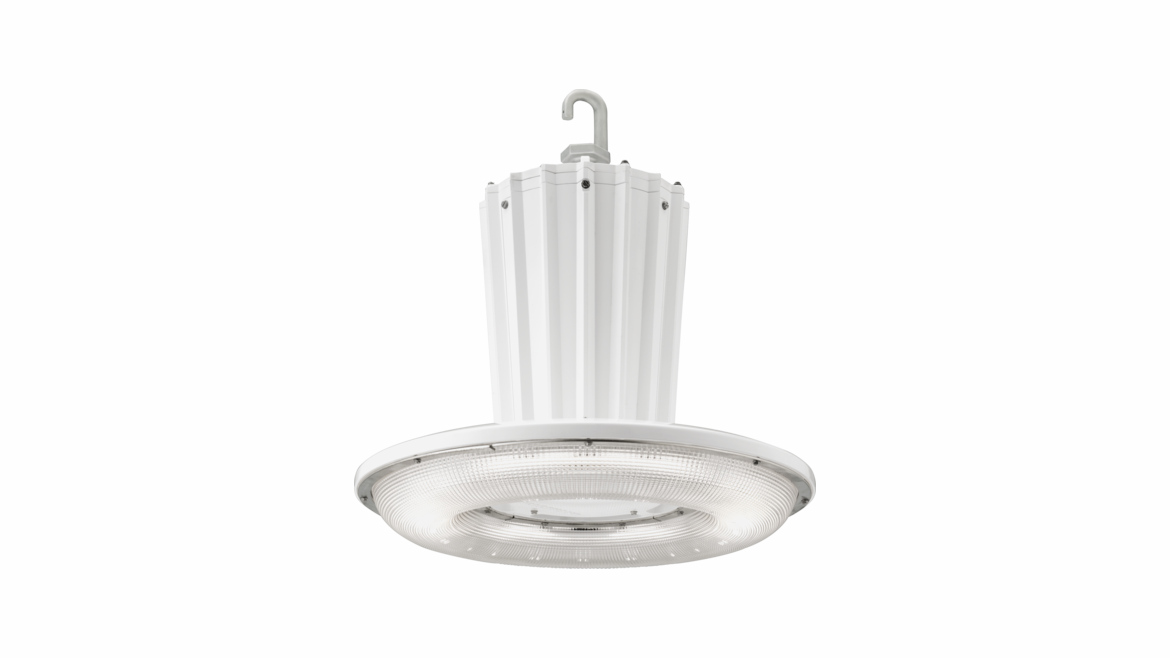
The Holophane Vantage LED luminaire meets the demands of food processing plants and cold facilities, with a sloped shape and corrosion-resistant finish that repels water and eliminates spaces where food, dirt or debris can accumulate. Courtesy Acuity Brands.
Wisconsin-based Kenall's TekDek LED fixtures combine motion sensing capabilities with glare reduction for temperature-controlled processing and freezer applications.
Facility operators are also placing greater emphasis on lighting systems that minimize maintenance.
While LEDs dominate new installations, induction lighting remains a niche alternative for facilities prioritizing extremely long service life. Tesla Induction Lighting Company markets its Tesla Bulb technology as an alternative to LEDs, offering flicker-free operation for 100,000 hours of operation.
Its Freezer-Bright wide-dispersion lamp can replace multiple fluorescent or metal halide fixtures while producing more light than four 400-watt metal halide high-bay fixtures, according to the company.
As facilities evaluate lighting upgrades, experts say factors like long-term performance, total cost of ownership and sustained energy savings should carry as much weight as initial purchase price.
"Products that appear similar can vary widely depending on their design approach. Factors like lumens per watt (efficacy) and driver and electrical component durability can significantly influence lifecycle cost, maintenance frequency and operational continuity," Kraft said.
According to the Global Cold Chain Alliance, energy is typically the second-highest cost for cold storage operators, behind labor. Image courtesy of imaginima / iStock / Getty Images Plus
Lighting performance becomes even more critical inside freezer environments, where low surface reflectance makes optical precision essential.
In high rack facilities, the ability to evenly illuminate both vertical and horizontal surfaces can significantly improve visibility and worker safety.
“We first focus on prioritizing appropriate foot candle levels, which measures the actual light level reaching the working surface. In low temperature environments where frost, condensation, and racking can reduce effective lighting, prioritizing foot candles ensures our associates can clearly see hazards, read labels, and operate material handling equipment safely, reducing the risk of accidents and loss,” said Brian Dunn, senior vice president of facilities & engineering; and head of sustainability at Americold.
Americold last year invested over$23 million in energy efficiency, including LED lighting upgrades. To date, the company has installed LED lighting in over 200 facilities.
“In 2025 alone, we converted more than 1,400 fixtures across 10 sites, reducing annual energy use by approximately 2 million kWh and avoiding about 1,400 metric tons of CO₂ emissions,” Dunn said. Fixture upgrades are just the starting point. More than 90% of Americold facilities capture real-time utility data, enabling targeted efficiency improvements and consistent performance tracking across regions."
He said the "real value comes from integrating lighting into a broader, data-driven operating environment. We can intervene early — whether that’s lighting in unoccupied areas or unexpected energy draw — before it impacts cost or performance. For our customers, this means more efficient, reliable operations across the facilities that support their supply chains as well as the ability to deliver those improvements consistently at scale."
Once the infrastructure is upgraded, maximizing savings requires a broader strategy that addresses how energy is purchased and managed across the operation.
Reviewing utility bills, supply contracts, interval data, load profiles, operating schedules and facility performance can uncover significant opportunities to reduce costs and improve operational efficiency.
"Energy has become a margin issue, not just a utility bill," said Dustin Scarpa, co-founder of Transparent Energy, an auction and brokerage firm specializing in large energy buyers. "That matters for refrigerated and frozen facilities because energy is not a secondary expense. Even a small difference in price per kilowatt-hour or dekatherm can have a meaningful impact when applied across a high-load facility or multi-site portfolio."
A 2025 study of more than 100 senior energy decision-makers at food and consumer packaged goods companies found that 91% pay above the U.S. industrial average of $0.08 per kilowatt-hour, while nearly half reported energy costs increasing by 26% or more over the previous five years.
"The strongest results usually come when both sides are managed together, reducing unnecessary usage while also making the remaining load more competitively priced and better protected from volatility," Scarpa said. "The opportunity for the industry is to treat energy as a strategic input, one that can be measured, competitively sourced, actively managed and aligned with both business and sustainability goals."
Looking for a reprint of this article?
From high-res PDFs to custom plaques, order your copy today!