AI Evolution Provides Vision Without Limits for IQF Food Inspection
Powerful inspection technologies are being trained to find foreign materials that are often overlooked.

Individual quick-frozen (IQF) food products are especially susceptible to product recalls caused by foreign materials.
Product recalls are a common nightmare shared by all food processors. Each recall can cost a company millions of dollars to locate and discard the affected products and pay any fines or legal action that may follow. Then, the long journey to restore consumer trust in the product or brand begins, which may take years and require more money through public relations efforts.
Individual quick-frozen (IQF) food products are especially susceptible to product recalls caused by foreign materials. The complexity of IQF food processing, beginning with harvesting and the field waste that typically travels with the product (stems, roots, rocks, etc.) and throughout the multiple processing and packaging phases, presents ample opportunity for foreign materials to enter.
Natural variations in IQF produce food products further complicate foreign material detection. The wide range of shapes, colors and textures in a package of frozen fruits or vegetables can make split-second determinations on good products and foreign materials nearly impossible for even a well-trained product inspector observing the line.
In recent years, there has been an increase in IQF food processing companies deploying image-based inspection equipment powered by artificial intelligence (AI) models for foreign material detection. The customizability and small footprint needed for these systems make them a desirable option to amplify food safety efforts. Still, it is essential to understand how they work and their limitations.
Sources of Foreign Materials in IQF Food Processing
There are truly endless ways foreign materials may infiltrate IQF food processing. Field debris like stones and twigs or packaging residue like plastic, paper, wood chips and ties from crates are all common hazards for incoming products. Foreign materials from equipment wear, including metal shavings from cutting machines or loose screws from worn-out conveyor systems, are also a common source of foreign material.
Of course, human error is another source of foreign material. Untrained or inattentive staff mishandling products or inadvertently adding materials to the line are common occurrences on IQF processing lines.
While some of these sources can be addressed and corrected with proper employee training, improved material handling and better maintenance protocols, the production pace and many steps in IQF food processing make foreign material detection a never-ending struggle for companies.
Emerging Role of AI in Food Safety
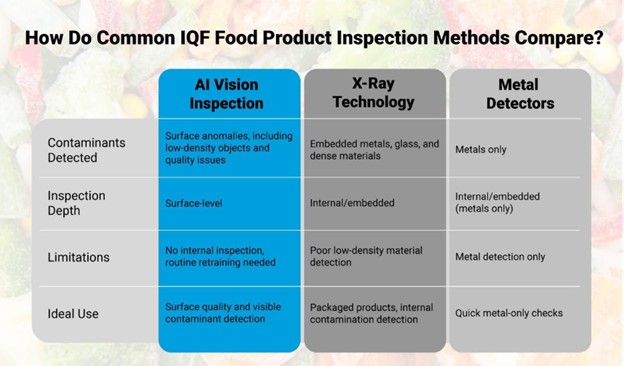
Outside of human inspectors, many IQF food processing companies use in-line metal detectors and X-ray systems to find foreign materials at critical process stages. X-ray systems are well suited for detecting dense foreign objects on a processing line, including materials that may be embedded in good products and not immediately visible. However, less dense or “soft” foreign materials like wood, paper, rubber, foam and plastic will typically go undetected by X-ray systems.
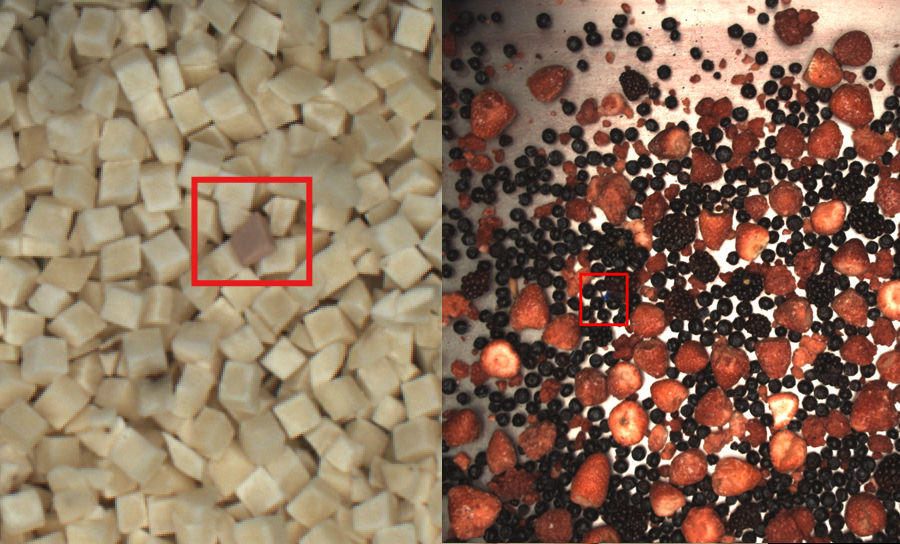
One of the main benefits of AI-powered vision systems is their ability to detect soft foreign materials from a processing line surface, including objects that may look similar to good products. The AI accomplishes this by interpreting what it sees against AI models, which are the criteria it uses to find and separate foreign material from the good product on the line. If a human inspector can spot a particular material on the line, then an AI model can be trained to detect that material.
Also, unlike traditional vision systems that rely on rule-based measurements programmed as pass/fail tolerances for specific product features, AI systems utilize machine learning to identify features based on the object's shape, texture, and other characteristics. This unique feature makes AI vision systems capable of distinguishing subtle foreign objects, including natural product variations. AI can identify anything from a green stem in green beans to translucent hard skins in chopped onions.
How AI-Powered Foreign Material Inspection Systems Work
AI-based vision inspection systems combine one or many high-resolution cameras with a software interface to take real-time images of products for AI analysis. Each foreign material AI model is created by showing the system several pictures of good products and images that include the targeted foreign material. With skilled training, the AI system learns how to identify foreign materials and trigger an alert or sound an alarm to an operator about the presence of foreign material. Some applications may include an automated rejection system tailored to a specific product to remove the material without stopping the processing line.
AI inspection can spot dense objects, too, but their effectiveness against traditionally challenging objects separates them from X-ray and metal detectors. However, AI vision systems for foreign material detection can only analyze the surface of the product passing under its camera. There are ways to accommodate this by using shaker tables or waterfall applications (e.g., installing a camera drop-off point in a conveyor system to inspect free-falling products).
For this reason and others, AI vision systems are not a drop-in replacement for X-ray and metal detector technologies but instead complement their analysis. IQF processors combine these technologies to achieve superior protection against foreign materials.
One common use of AI product inspection in IQF food processing occurs just before dicing the product. Capturing foreign materials at these stages not only prevents them from being cut into smaller pieces and affecting more products, but it also helps avoid potentially damaging the processing equipment.
Another common spot for AI inspection at IQF plants is the intake of raw products. Once again, capturing and eliminating foreign field debris before later processing stages is essential for protecting processing equipment and ensuring against further product contamination in later processing stages.
Many processors also use AI inspection technologies immediately after freezing, providing a final check for contaminants before packaging and distribution. What makes AI especially valuable for IQF environments is its ability to adapt to product variations and improve over time. Operators can retrain the system with minimal reprogramming to detect new foreign materials, seasonal variations, or product types.
AI-based vision systems also integrate with an IQF facility’s MES system, ERP software, or other cloud-based analytics to help enable valuable operational insights and enhance line efficiency. Furthermore, AI inspection systems contribute to stronger traceability and compliance readiness. By creating a digital audit trail that quality teams can use to investigate root causes, validate corrective actions, and demonstrate compliance with regulatory agencies, IQF processors can take greater command of process control and food safety with AI’s help.
Planning Considerations for AI Vision Inspection Systems
While AI-powered vision inspection offers powerful advantages for IQF processing and food safety, careful implementation is necessary. One of the immediate considerations is the need for high-quality AI model training data. These systems rely on large volumes of accurately labeled images for the AI system to learn the differences between acceptable products and foreign contaminants. For IQF processors with a wide range of mixed products, compiling enough examples of all potential defect types – especially rare or low-frequency materials – is an intensive process. Enlisting the assistance of an AI training expert can help streamline this effort.
AI inspection systems must be carefully calibrated within the fast-moving IQF line. Reliable detection requires some modification to conveyors or processing equipment to achieve optimal camera angles, lighting conditions, and product spread.
The limitations of traditional foreign material detection methods in IQF processing are increasingly apparent, especially as consumer and regulatory demands for food safety continue to rise. AI-powered vision inspection technologies are a compelling solution to meet these demands, offering accurate foreign material detection that needs the speeds and flexibility required in today's IQF operations. With the ability to detect a wide range of contaminants in real time and adapt to ever-changing product types, AI vision systems help IQF processors move beyond reactive quality control to a more predictive, data-driven approach.
AI inspection is no longer a futuristic concept – it is a practical, proven tool several food processing companies use today to enhance food safety. It offers a new and exciting way for IQF companies to take proactive steps toward more innovative and safer operations.
Looking for a reprint of this article?
From high-res PDFs to custom plaques, order your copy today!