From the Cold Corner Podcast
‘Flat Screening’ the Fridge: How Peltier & OPEX Aim to Disrupt Cold Storage
OPEX Corporation earlier this year announced a technology partnership with Peltier to offer a first-of-its-kind, multi-temperature zone, multi-deep cold storage solution for automated fulfillment systems.
This groundbreaking innovation allows organizations to integrate refrigerated and frozen inventory directly into ambient warehouse environments, boosting operational efficiencies in labor, footprint and energy.
Using the OPEX Perfect Pick ASRS, customers in grocery markets can store and retrieve refrigerated and frozen products utilizing Peltier’s actively cooled, AI-enabled totes, eliminating the need for costly freezer chambers or specialized infrastructure.

"Many of our customers have expressed a need for multi-temperature capabilities but are often dissuaded by traditional solutions that require costly infrastructure and complex system changes," said Monty McVaugh, head of product, Warehouse Automation at OPEX."By integrating Peltier’s tote technology into our existing framework, we can now deliver a flexible, scalable, efficient and highly cost-effective solution without modifying core systems. It does not require any segmenting or zoning between ambient refrigeration or freezer storage areas. In fact, we can actually intermix refrigeration in frozen totes in the same storage bay."
Designed with individually controlled temperature setpoints and IoT connectivity, the Peltier Tote enables real-time monitoring and management of storage conditions through integrated API messages. Power is provided to each tote while in muti-deep storage, and temperatures are maintained during transport by OPEX iBOT robotic vehicles, ensuring continuous cold chain integrity.
"The Peltier Tote is fundamentally changing how the world applies cold storage in commerce," said Hanson Li, CEO and co-founder of Peltier. "Together, OPEX and Peltier are delivering an advanced solution that breaks the traditional paradigm, where cold and temperature were treated as major constraints. Customers can now optimize operations, processes and space without these concerns. We’re proud to be partnering with OPEX to offer a consequential solution to what has been a longstanding challenge for so many."
Peltier’s Modular Cold Chain (MC²) is a patented, scalable, solid-state cooling ecosystem.
Named in honor of Jean Charles Peltier, the French physicist who in 1834 discovered the presence of heating or cooling at an electrified junction of two different conductors. Heat can be generated at one junction and absorbed by the other.
Unlike conventional cold storage rooms, where refrigeration failure can result in total product loss, the Peltier Tote isolates potential issues to individual container level, minimizing risk to product quality and waste.

How Peltier & OPEX Aim to ‘Flat Screen’ the Fridge
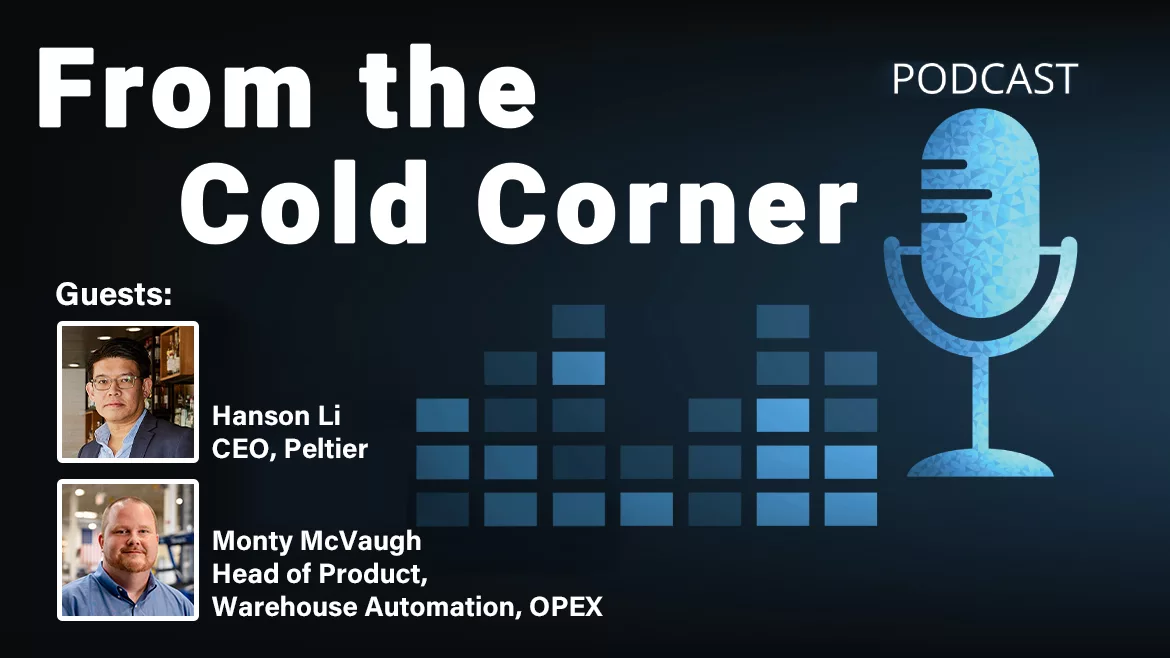
Warehouse automation provider OPEX Corporation recently announced a technology partnership with Peltier to offer a first-of-its-kind, multi-temperature zone, multi-deep cold storage solution for automated fulfillment systems. Designed to maximize operational savings via labor, space and energy, the system allows grocery and ecommerce to enhance cold chain operations without freezer infrastructure. To learn more about how this technology is disrupting temperature-controlled logistics and its potential future applications, Monty McVaugh, who leads product management for the warehouse automation business line at OPEX and Hanson Li, co-founder and CEO of Peltier, joins From the Cold Corner.
"It's the size of your mid-sized Igloo that you might have in your garage, except that instead of being just a passive cooler with insulation, where you still have to put ice inside, ours have an active refrigeration or freezer engine on board. We're able to build lightweight, modular fridges and freezers, because we are not using compressors, we're not using refrigerants as a driver of cold, instead we use semiconductors," Li said. "That is the core physics underneath it and the innovation is we have improved the material science of the semiconductors."
The system’s AI capabilities drive dynamic energy management and provide detailed reporting for sensitive products, including those subject to strict FDA regulations.
Removing infrastructure from the equation allows the cold chain to be looked at in diverse ways.
"I could see in the future that every house has some type of actively cooled apparatus sitting on their front porch … and then when you come home, you just unlock it with a smart lock or a PIN code on your phone," McVaugh said.
Li agreed.
"The cold chain is transforming in front of us. An analogy I like using is we take for granted that you can put a TV screen on any surface. It's only an inch, it's lightweight, you can mount it anywhere," he said. "Rewind 30 years ago. The idea of putting a big old TV on a wall is inconceivable. Now, you can hold one in your hand, right? So, it's really the idea, what happens when we flat-screen a fridge? How else will we use it?"
Looking for a reprint of this article?
From high-res PDFs to custom plaques, order your copy today!