Cold Energy Management: Spend to save
Cold warehouse operators say LED lighting makes dollars and sense.
 Watt’s up? Having heard so much about light emitting diode (LED) industrial lighting, Refrigerated & Frozen Foods was interested to learn if cold storage warehouse operators indeed found cold, hard cash returns in this new technology.
The answer is “yes,” say executives at the Tippmann Group / Interstate Warehousing, Ft. Wayne, Ind.; and United States Cold Storage, (USCS), Voorhees, N.J.
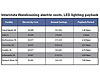
Mike Lynch, USCS vice president of engineering, says his company already has spent about $2.7 million to retrofit and install LED lighting at nine warehouses.
“During the past 24 months, we have tested numerous LED fixtures from a variety of manufacturers,” says Lynch. “The energy savings – coupled with available utility incentives – made 2011 an opportune time to make this investment. In fact, USCS plans to make additional investments in 2012 thanks to the continued availability of utility incentives and the continued reduction in LED costs. Meanwhile power costs continue to increase.”
Lynch notes that LED lighting has other advantages beyond power savings. It requires less wattage – resulting in less heat emitted into the freezer. He says LED’s provide infinite dimming capabilities (0 to 100 percent) and they can turn on instantly at temperatures as low as -20
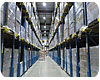
 Cold storage and distribution services giant Americold, Atlanta, selected SmartWatt Energy for a LED lighting retrofit at Americold’s cold storage facility in Russellville, Ark. The August 2011 project was the seventh such collaboration for the two companies. Officials said they expected the effort to generate higher quality lighting while reducing overall lighting-related energy consumption by 690,000 kWh – equivalent to removing more than 95 cars from Arkansas roadways. Americold owns and operates more than 182 temperature-controlled warehouses in the United States, Australia, New Zealand, China, Argentina, and Canada.

Whether you’re considering plain LEDs or intelligent LED lighting systems, be sure the any product meets the following criteria:
• Underwriters Laboratories (UL) Listing – Any LED product should be UL listed for the entire fixture – not just the power supply. Don’t hesitate to ask for proof.
• DesignLights Consortium (DLC) Qualified Products List – The Energy Star™ program rates many products including residential LEDs. When it came to industrial high-bay LEDs, Energy Star partnered with the DesignLights Consortium (www.designlights.org) to develop a rigorous set of evaluation criteria. When products meet the critieria, they are added to the DesignLights Consortium’s Qualified Products List (QPL), which is used by numerous utilities nationwide as primary eligibility for project rebates.
 The DLC certification process requires lighting manufacturers to provide documentation, including the product’s rated and measured data for various properties including photometric, electrical and lumen depreciation. Required data comes from the LM-79, LM-80 test files, as well as full IES files and UL 1598 certification. (Note: vendors should be willing to share this data with you, as well.)
The DLC represents a collaboration of utility and state energy efficiency programs from across North America, NEEP (Northeast Energy Efficiency Partnerships), the Lighting Research Center, and regional energy efficiency organizations. By providing a rigorous set of evaluation criteria for prospective vendors, DLC promotes high-quality, energy-efficient lighting standards in all commercial lighting market sectors.
• Lighting Facts –This Department of Energy initiative ensures consistent product labeling. Lighting Facts is a program designed to teach customers about this new technology because solid state (LED) lighting is measured in light output levels rather than wattage.
The answer is “yes,” say executives at the Tippmann Group / Interstate Warehousing, Ft. Wayne, Ind.; and United States Cold Storage, (USCS), Voorhees, N.J.
Mike Lynch, USCS vice president of engineering, says his company already has spent about $2.7 million to retrofit and install LED lighting at nine warehouses.
“During the past 24 months, we have tested numerous LED fixtures from a variety of manufacturers,” says Lynch. “The energy savings – coupled with available utility incentives – made 2011 an opportune time to make this investment. In fact, USCS plans to make additional investments in 2012 thanks to the continued availability of utility incentives and the continued reduction in LED costs. Meanwhile power costs continue to increase.”
Lynch notes that LED lighting has other advantages beyond power savings. It requires less wattage – resulting in less heat emitted into the freezer. He says LED’s provide infinite dimming capabilities (0 to 100 percent) and they can turn on instantly at temperatures as low as -20
Make the call
Before you begin a lighting project, contact your local utility – either directly or through your energy efficiency consultant. You’ll want to learn about applicable rebates and incentive programs. You may find a variety of opportunities for simple lighting upgrades as well as larger incentives for integrating controls. If your kWh savings are significant enough, you may be eligible for additional project rebates. You should know, however, that it’s key to contact utilities before a project starts. Many utilities will not provide incentives if they come in midway through a project.Field Reports
Millard and Groom Energy announced in December that they completed a LED lighting retrofit at Millard's public refrigerated warehouse in Allentown, Pa. Covering more than 629,000 square feet and using nearly 800 LED high bay fixtures, officials say the project is one of the nation’s largest LED deployments. Millard said it expects the project (1) to cut 3.5 million kilowatt hours in lighting and cooling system operation and (2) eliminate more than 1,700 tons of related CO2. Millard, Omaha, Neb., is one of North America’s largest public refrigerated warehouse and distribution service providers with 36 regional facilities.LED lighting: Be an informed buyer.
Suppliers say several organizations promote energy-efficient lighting and hold manufacturers to consistently high standards. These groups include utility representatives, lighting academics, industry experts, U.S. Department of Energy representatives and other interested parties. These groups form a common framework to educate customers and review vendor claims.Whether you’re considering plain LEDs or intelligent LED lighting systems, be sure the any product meets the following criteria:
• Underwriters Laboratories (UL) Listing – Any LED product should be UL listed for the entire fixture – not just the power supply. Don’t hesitate to ask for proof.
• DesignLights Consortium (DLC) Qualified Products List – The Energy Star™ program rates many products including residential LEDs. When it came to industrial high-bay LEDs, Energy Star partnered with the DesignLights Consortium (www.designlights.org) to develop a rigorous set of evaluation criteria. When products meet the critieria, they are added to the DesignLights Consortium’s Qualified Products List (QPL), which is used by numerous utilities nationwide as primary eligibility for project rebates.
The DLC represents a collaboration of utility and state energy efficiency programs from across North America, NEEP (Northeast Energy Efficiency Partnerships), the Lighting Research Center, and regional energy efficiency organizations. By providing a rigorous set of evaluation criteria for prospective vendors, DLC promotes high-quality, energy-efficient lighting standards in all commercial lighting market sectors.
• Lighting Facts –This Department of Energy initiative ensures consistent product labeling. Lighting Facts is a program designed to teach customers about this new technology because solid state (LED) lighting is measured in light output levels rather than wattage.
Looking for a reprint of this article?
From high-res PDFs to custom plaques, order your copy today!