Maximum Exposure
For many cold food processors, even the littlest bit of sunlight is a blessing for cold energy management.
Whether food companies build, expand or revamp their facilities, they’re reaping the benefits of installing solar roofing and other technologies that achieve more than letting in a bit of natural light.
Agriculture Solar, for example, has worked specifically on creating solutions for the refrigeration industry, says Seth Pepper, director of communications for the Tucson, Ariz., company.
“Given the challenge inherent in refrigerated structures of limited space and high energy demands, every precaution has been taken to create a turn-key solution
| “Given the challenge inherent in refrigerated structures of limited space and high energy demands, every precaution has been taken to create a turn-key solution from the inside-out." |
from the inside-out,” he adds.
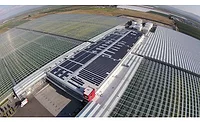
That’s why Agriculture Solar built a solar roofing system using its proprietary-designed sun tracking system, which provides up to 30% increase in power production. Plus, its non-penetrative, exo-skeleton design takes the weight load and displaces it throughout the entire structure.
“The Agriculture Solar tracking systems are mechanical devices attached to several solar panels, which follows the direction of the sun and ensures that the modules are tilted for maximum exposure,” says Chuck Helmke, systems designer.
For its part, SolarWorld provided high-performance panels for a 4.26-megawatt installation on a 17-acre commercial rooftop in partnership with Solar Nation, a Portland, Ore.-based solar design, engineering and construction firm, according to Devon Cichoski, media relations manager for SolarWorld, Hillsboro, Ore.
“Solar Nation undertook the project on top of a 656,255-square-foot warehousing and distribution facility owned and operated by Avidan Management, based in Newark, N.J.,” Cichoski adds. “The system produces enough energy to supply more than half of the power needs of the building’s 17 tenants, which use the space for storage of dry, refrigerated and frozen goods.”
However, solar applications within the food processing and cold storage industries are not limited to rooftops, Cichoski notes.
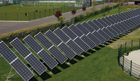
Last year, SolarWorld worked with Dynamic Solar, LLC, a Wayne, Pa.-based solar developer, to supply a 777-kilowatt, ground-mounted solar array to John F. Martin & Sons Inc., a meat and cheese producer in Stevens, Pa.
“The project consists of more than 3,000 SolarWorld solar panels and will produce approximately 1 million kilowatt hours of power each year,” Cichoski says. “Martin & Sons will save approximately $100,000 annually and hedge against rising electricity prices, thanks to their solar investment.”
The roof, the roof, the roof is on “fire”
When it comes to mounting solar panels on the roof though, there can be some cause for concern.
“Some clients at first were hesitant to put solar on the roof with concerns of load requirements and penetrating the roof membrane with possibly voiding warranties,” says Pepper. “However, Agriculture Solar has designed and manufactured an exo-skeleton system that makes it possible to dissipate the weight of the system by using pre-existing structure points, while also requiring no penetration to the roof whatsoever.”
Plus, refrigerated and frozen food processors must make sure that they have enough space on their roof to fit the solar panels, Pepper adds.
“With systems going in on the West and East Coast major port areas of the United States and in areas of Canada, the Agriculture Solar refrigeration systems are allowing customers to save and ultimately stabilize their operating costs. In refrigeration, the main objective is dealing with utility company expenses.”
In addition to rooftop space and weight limits, companies also face challenges with regards to high energy requirements, financial goals and power production.
“[Roof-mounted solar systems] must also be installed in a way that protects the integrity of the roof and preserves the building owner’s warranty,” Cichoski says. “In addition, because rooftop space is often physically limited, the system should produce a high-energy yield relative to its physical size, using solar technology that guarantees power output over the 25-year life of the system’s warranty.”
Cichoski also recommends that business owners select high-quality solar panels that offer a sound warranty, guaranteed power output, proven quality control and high environmental standards.
“For example, ballasted racking materials can be used on roofs where traditional roof-penetrating racking systems are unacceptable,” Cichoski adds. “With so many new entrants into the solar industry manufacturing panels around the globe, it is more important than ever for customers to be confident that their system is built to last.”
The future is here
The future for refrigeration and frozen food facilities is here and now. Whether it’s using solar, wind, LED lighting, heat recovery or energy storage systems, the goal is for all producers to achieve energy independence and maximum exposure.
“With our further integration of distributed generation wind turbines and energy storage, a facility can become its own utility company in essence,” says Helmke. “We want to literally give the power back to our customers. It is an exciting time and important role that we are responsible for.”
Shedding Light on Classrooms
It used to be that today’s youth read from their history books while seated below a gigantic fluorescent light. Now, it’s all about educating children on those lights.
SolarWorld created Solar2Schools, a program that brings photovoltaic systems and solar energy education to the nation’s elementary, middle and high schools.
“Through the program, participating schools receive not only solar panels and monitoring systems, but also assistance in developing curriculum based on solar science and engineering,” says Devon Cichoski, media relations manager for the Hillsboro, Ore., energy solutions provider.
SolarWorld also launched Solar2World, a program that helps improve the quality of life for those in developing nations by giving them access to electricity.
“From the United States, the Solar2World program focuses on rural electrication projects in Latin American communities,” Cichoski adds.
Looking for a reprint of this article?
From high-res PDFs to custom plaques, order your copy today!