FARM TO FROZEN
The Cold Reality: Why America's Cold Storage Capacity is Running Low
September 5, 2023
FARM TO FROZEN
The Cold Reality: Why America's Cold Storage Capacity is Running Low
September 5, 2023Courtesy Getty Images

At my local grocery store in Lakeway, Texas, I’ve noticed a pattern taking place about every six months or so. Once a year, sometimes twice, and certainly since the COVID-19 pandemic, my local supermarket rearranges its aisles and adds to its frozen and refrigerated sections. Sure enough, the section of the store that once housed paper towels and toiletries, is now lined with freezer cases full of staples like frozen pizza and ice cream, as well as innovative and emerging frozen food entrée and snack brands. It's apparent even from the store’s shelf space that the consumer sentiment has shifted rapidly towards preservative free, fresh and frozen foods. As consumers, we are now in a golden age of food innovation. Brands large and small are responding to our desires with creativity and originality.

There’s one problem however. Though it is (fairly) simple for the grocery store to rearrange their aisles, it is much more difficult for the manufacturers to procure and reconfigure their cold chain. To quote my partner and Yukon’s Director of Development, Axel Anderson, “All the easy sites have been taken.” Indeed, in an era of near 0% vacancy and expensive, or non-existent land sites, manufacturers are struggling to find a relief valve for growing space needs.
So how did this happen? Not unique to cold storage, industrial development of all types has faced competitive, regulatory and pricing pressures over the last 10 years. With the explosion of online shopping, large volume distribution centers have begun springing up on greenfield sites across every major city in the country. Companies of all types have been competing for sites with the easiest highway access, the most eager labor pools and, most importantly, the densest population centers. Further, mega companies like Amazon and Walmart have been investing millions into creating the highest efficiencies in their supply chain inside their warehouses. By stretching the productivity of each facility, these deep-pocketed companies have been able to manufacture margins that smaller companies simply cannot match. This operating efficiency has allowed them to buy or lease the very best sites in every city. This market is so competitive that smaller brands face the decision of either settling for a less-than-ideal location or paying a premium for the most desirable available locations.
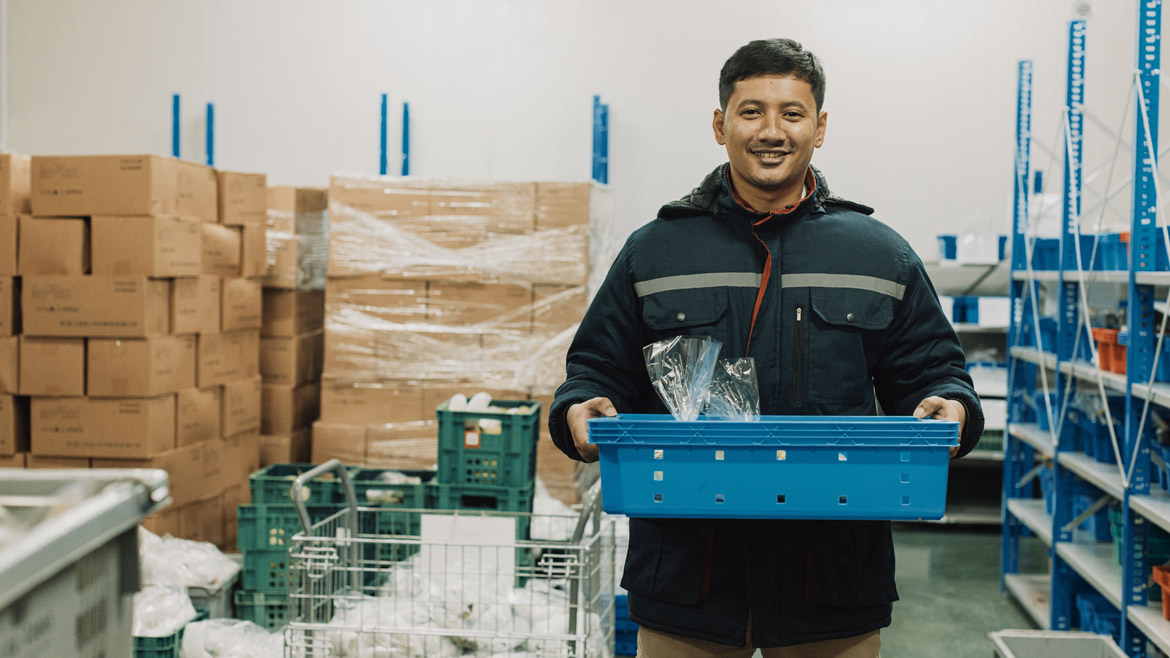
Now let’s discuss how this competitive environment becomes even worse for cold storage users. The very real estate developers who are most likely to build more cold storage facilities are industrial developers who are experts in site acquisition, planning and approvals, and construction of industrial real estate. However, these developers have historically focused on tilt-up construction dry storage buildings, which cost roughly $60-$90 per square foot to build, with an almost unlimited number of potential tenants.
Cold storage, by comparison, has historically cost anywhere between $200-$300 per square foot for a prototypical public refrigerated warehouse, and serves a much more limited pool of potential tenants. For this reason, industrial real estate developers are often reluctant to pursue speculative cold storage developments. In recent years, we have seen several intrepid developers attempt to meet the growing demand by in fact building speculatively, but the pace at which this is happening is nowhere near the demand that is currently estimated. In fact, national real estate firm CBRE estimates that the demand for cold storage space in the U.S. will only continue to grow, with an unmet need of nearly by 100 million square feet.
These trends, coupled with the fact that prior to 2019, there hadn’t really been a speculative cold storage building built in roughly 30 years, means the demand is real. And, remember, the average cold storage facility in this country is 40 years old. Unfortunately, the problem only gets worse for processors and manufacturers. Unlike public refrigerated warehouses, which have started to converge into a more or less prototypical building, processing and manufacturing facilities are specific to individual users, with unique details that make “prototypes” nearly impossible. As difficult as it is to speculate on what cold storage warehouses needs to look like (temperatures, clear heights, bay sizes, etc.) compared to a dry warehouse distribution center, it is that much more difficult to speculate on how to configure a processing and manufacturing building to accommodate the highest amount of potential tenants. This then leaves processors with two options. The first, building for themselves, can be incredibly expensive and arduous, not to mention distracting from their core business. The second, occupying an existing building that fits or can be reconfigured to fit their needs, is like finding a needle in a haystack. The building must not only have the right size, refrigeration, configuration and location, it must also be available. No small feat.
Indeed, the average food supply chain executive faces all of these headwinds, and more, when searching for additional refrigerated or frozen space. In the next article, we’ll begin to dive in on specific strategies and tutorials for how to navigate these challenges and come out the other side with the added capacity so desperately needed by today’s food and beverage manufacturers, processors and distributors. We’ll start with a general exploration of the different categories of options including ground-up development, acquisition, and leasing. Later in the series, we’ll dive into each category with thought exercises and recommended steps to take.
Looking for a reprint of this article?
From high-res PDFs to custom plaques, order your copy today!