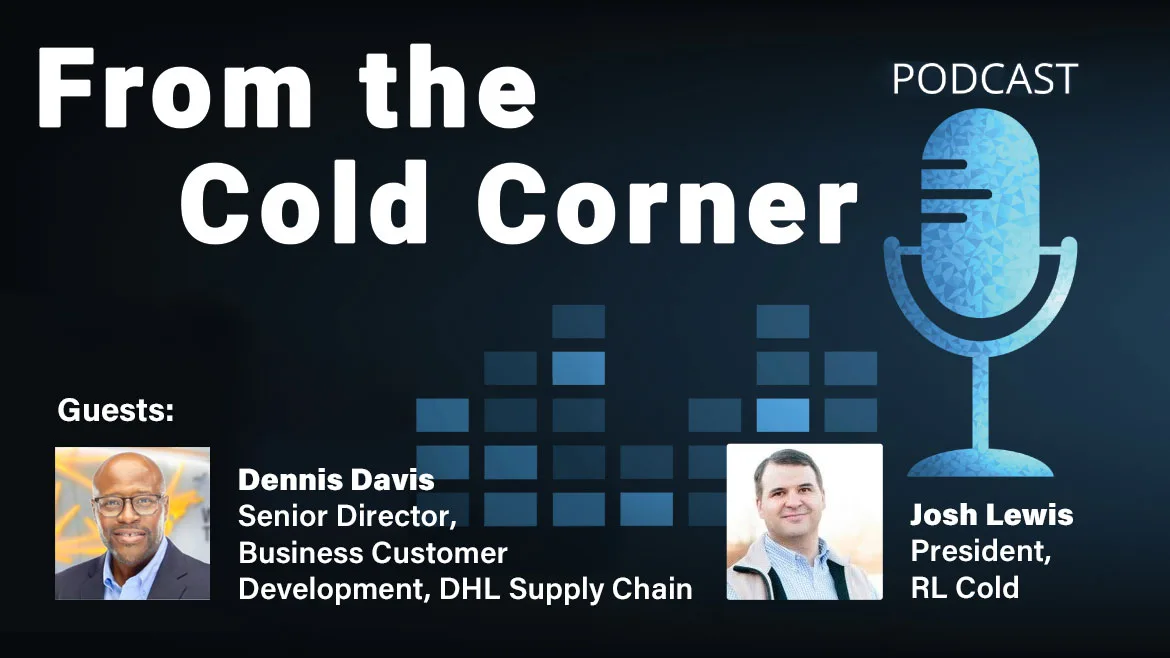
From the Cold Corner Podcast
DHL Supply Chain, RL Cold Slate Next-Gen Network
DHL Supply Chain and RL Cold are betting big on purpose-built facilities designed for flexibility, visibility and long-term scalability.
The third-party contract logistics provider earlier this year signed a memorandum of understanding (MOU) with RLCold, a real estate development firm specializing in cold storage warehousing and processing for the food and beverage (F&B) sector, to develop more than 5 million square feet of advanced temperature-controlled facilities across North America.
Under the agreement, DHL will combine its operational expertise and customer insights with RLCold’s design, project management and construction capabilities to accelerate the delivery of food-grade cold storage solutions.

Dennis Davis, senior director of business customer development, DHL Supply Chain Headshot courtesy of DHL Supply Chain
The initiative comes when much of the existing network was built decades ago and is struggling to keep pace with modern food distribution demands.
“For us, it was really three factors that were converging in the industry,” said Dennis Davis, senior director of business customer development at DHL Supply Chain. “The demand is shifting to a more complex distribution model, but the cold storage infrastructure is aging and not really designed for that. Secondly, regulatory pressures like the FDA traceability requirements are raising the bar on visibility and compliance. And third is speed to market. Customers are looking for more modern facilities delivered faster than what the industry has historically done.”
The partnership will offer both dedicated and multi-tenant facilities, allowing customers the flexibility to scale seasonally and by channel.

Josh Lewis, president, RL Cold. Headshot courtesy of RL Cold
It pairs DHL’s and customer network with RL Cold’s development platform and experience building cold storage facilities from the ground up.
“What we were seeing was that a lot of groups were acquiring existing buildings, but that didn’t solve for aging infrastructure,” said Josh Lewis, president of RL Cold. “Customers loved the new facilities we were developing, but they still needed a world-class operator. That’s where DHL was a natural fit.”
The companies are already pursuing projects in several key markets, including central California; Boise, Idaho; Salt Lake City, Utah; Philadelphia, Pennsylvania; and Lakeville, Minnesota.
In addition to meeting Food Safety and Modernization Act (FMSA) 204 requirements, the facilities will include multi-temperature zones and docks; humidity management and air quality control systems; as well as high-clearance, high-density racking. Additionally, airtight construction, advanced refrigeration controls and sustainable energy solutions will optimize operation costs and reduce carbon footprint. DHL’s IT platforms and operational solutions will provide end-to-end visibility, supporting food-safety programs.
While each facility will vary by customer requirements, both emphasized that future development will be driven by supply chain strategy rather than available real estate.
“Five million square feet is ambitious, but it’s needed,” Lewis said.
“The traditional model was always, ‘Where’s the available space?’” Davis said. “We’re approaching customers with a different question: ‘Where do you need to be and how can we be part of that long-term strategy?’”
Designing those facilities requires balancing current needs with future flexibility. Lewis calls it “whole-brain warehousing.”
“The magic happens inside the four walls,” he said. “It’s designing buildings that are flexible enough to serve customers today and 15 or 20 years from now. That means things like underfloor heating, higher insulation values, scalable refrigeration systems, super-flat floors for automation and electrical infrastructure that can support future technologies.”
Listen to the podcast here:

DHL Supply Chain, RL Cold Slate Next-Gen Network
Demographic shifts and the rise of online grocery and food delivery services are driving demand for strategically located, multi-node cold storage networks. Dennis Davis, senior director of business customer development at DHL Supply Chain and Josh Lewis, president at RL Cold discuss the partnership’s plans for 5 million square feet of new space across North America.
▶ For more, listen to the podcast or download it from your preferred platform.
At the same time, food manufacturers are demanding greater visibility into their operations. Davis said customers increasingly want partners that can provide real-time inventory tracking, traceability and broader supply chain services beyond storage alone.
“They need more than storage,” Davis said, pointing to flexibility, visibility and infrastructure modernization as the three pillars that will define the next decade of food logistics.
“We know that 70 to 80% of the cold storage infrastructure out there today is more than 30 years old,” he said. “It’s not going to stand up to the rigor that will be necessary in the next decade. That’s why we believe this partnership is so important.”
Looking for a reprint of this article?
From high-res PDFs to custom plaques, order your copy today!