Helping Food Manufacturers Make the Right Refrigeration Choices
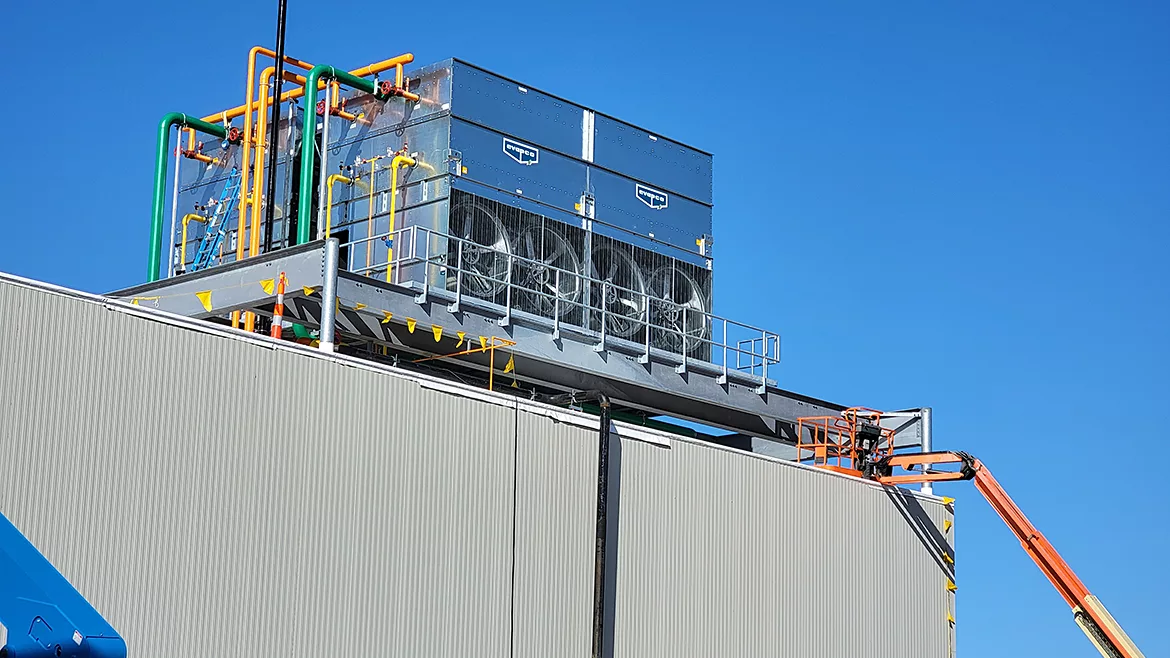
The weight of the refrigeration units needs to be taken into consideration both in terms of the structural capacity of the flooring and rooftop. Courtesy of The Austin Company.
When building food manufacturing plants, it is vital to understand the product and the process for producing, packaging and storing raw materials, and the end product. This is coupled with mechanical and electrical design complexities, sanitation issues, energy-saving measures, Food Safety Modernization Act (FSMA) compliance and equipment integration. It is no wonder that many factors need to be weighed, whether you are building a new facility or upgrading an existing plant.
Nearly all food plants have refrigeration and temperature control requirements. Therefore, it is crucial to understand how to meet these needs most efficiently and cost-effectively. This process begins with knowing your options.
Ammonia Refrigerant
Commonly used in meat processing plants, dairies and the brewery industry, ammonia refrigerant is highly effective when the cooling needs are significant. Cooling needs over 200 tons (1 ton = 12,000 BTUs per hour) is a good fit for an ammonia system. Ammonia is more efficient because its systems require less power to remove a unit of heat energy than other refrigerants. This difference is notable in low-temperature applications: the lower the refrigeration temperature, the greater the efficiency difference when using ammonia compared to other refrigerants, such as halocarbon.
While ammonia is an environmentally-friendly option, it can be dangerous. Ammonia is highly toxic, making leaks potentially lethal. This is why it’s allowed only in industrial systems with monitors and alarms. In addition, plants with more than 10,000 pounds of ammonia on-site must have a process safety management (PSM) plan. Some owners may want to limit the amount of ammonia in a refrigeration system to reduce the paperwork required with a full-scale PSM plan.
A suitable option can be a modular low-charge ammonia system. These units are mounted to a structural steel base and occupy a relatively small area within a facility or on the rooftop.
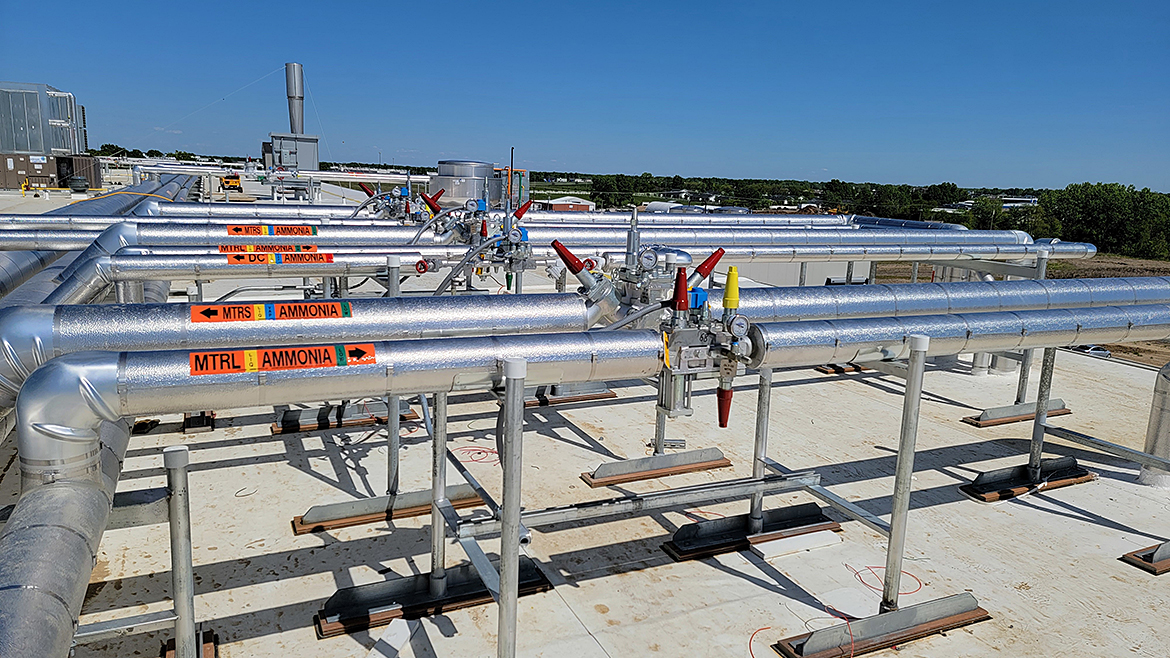 Commonly used in meat processing and dairy plants, ammonia refrigerant is highly effective when the cooling needs are over 200 tons.Courtesy of The Austin Company.
Halocarbon (Freon) Refrigerants
Low global warming potential (GWP) refrigerants R-513A and R-454B are recommended in lieu of widely used HFCs R-134a, R-410A, and R-407C. As of 2020, R-22 is no longer produced or imported into the United States but still exists inside some older HVAC units. For a refrigeration capacity of fewer than 200 tons, a halocarbon (i.e., Freon) system is typically the more cost-effective option than ammonia. To determine cost savings, a load calculation can be run.
It is also essential to factor in safety concerns. For example, Halocarbon is odorless and requires oxygen sensors to identify potentially harmful leaks.
Types of Refrigeration Systems
Unitary systems (packaged systems) have the condenser built inside a metal cabinet. These systems are typically used for cooling and have an evaporator inside the room connected to a condenser located outside. The evaporator has circulation fans that blow air through cooling coils. Evaporators can be placed in blast chillers, freezer boxes, storage and processing rooms.
Chiller Systems are indirect systems that use either water or a water-glycol mixture. The refrigerant (typically halocarbon) chills the water or water-glycol. It is then circulated (pumped) to the locations where it is used to remove the heat from the environment. Chiller systems are commonly used for chilling bakery ingredient water, vegetable processing water, die heads in packaging equipment, milk storage tanks, cook/chill systems and barrels for extruders. Most chiller system applications utilize halocarbon as the refrigerant. However, using an ammonia-glycol heat exchanger is one method for reducing the amount of ammonia stored on site. With this application, ammonia use is limited to the area or room where the compressors, vessels and other equipment is located.
Cryogenics is the application of low temperature from absolute zero (-273.15 degrees C) to -150 degrees C. Cryogens in food processing and preservation have allowed for greater atmosphere and temperature control. Ultra-rapid freezing is common in producing dairy products such as ice cream and can be used to effectively transport frozen foods. However, while it typically has a lower upfront capital cost, the operating cost of a cryogenic system may be greater than a mechanical system.
In a liquid nitrogen chiller or freezer, the liquid nitrogen is sprayed from nozzles inside the cooling chamber of the equipment and changes into a liquid and a vapor. When the liquid droplets touch the product surface, they vaporize, which removes heat from the product. This process is used in food processing in several applications, including grinding, mixing, coating, freezing and packaging foods.
Rack-mounted systems are typically used in the grocery industry and have a steel rack with a steel frame that contains multiple compressors. If one compressor fails, the others will help carry the load. A remote air-cooled condenser is outside the building, typically on the roof. This condenser propels the heat to the outside environment.
Building Design Elements
Regardless of the type of system an end user selects, critical areas of the plant are impacted by refrigerants. Key considerations related to refrigeration include drainage, unit weight capacity, ice and humidity collection areas and temperature increases due to solar radiation. It is vital to design your refrigerated areas in accordance with regulations, codes and guidelines for sanitation. Food processing drainage systems require thorough, rigorous cleaning. This is time-consuming and costly. Choosing a drainage system that can minimize your cleaning and labor costs is a worthwhile endeavor. The weight of the refrigeration units needs to be taken into consideration both in terms of the structural capacity of the flooring and rooftop. When designing refrigeration areas, it’s essential to consider temperature changes, avoiding ice build-up and condensation.
Just as the internal environment needs to be controlled, so does the impact of solar radiation from the plant’s building envelope. Therefore, a thermal break must be provided between the floor slab of isolated refrigerated areas and adjacent floor slabs. A floor-warming frost heave prevention system is needed to prevent floor slab cracking and damage to support structures and foundations where the temperature is consistently maintained below freezing.
At doorways, from refrigerated areas to adjacent areas, condensation can form on the floor and could result in ice formation on the floor. Therefore, a floor heating system for anti-slip is needed for small floor areas outside nearby doors. Frost protection needs to be considered for the overhead doors and swing doors to avoid damage to the door seals and to keep the doors shutting tightly. Drain lines from evaporators need to be protected from freezing with insulation and heat tracing. Copper piping is recommended for drain lines in areas below freezing.
Making the right choices for a food plant isn’t a single decision but a series of them. It takes a team of seasoned professionals to put all the pieces together. Maneuvering these complexities by learning as much as possible and carefully weighing efficiencies and cost considerations will lead to success. Smart refrigeration and facility design choices can be a cost-saving investment that pays dividends for years to come. Knowing more about your choices and building elements puts you on the road to running a successful food plant.
Looking for a reprint of this article?
From high-res PDFs to custom plaques, order your copy today!